
__27238.jpg)
__53190.jpg)
Solutions

Industries
Solutions

Industries

Ruggedizing Edge AI for Maritime Object Detection

Neteon
January 15, 2026
Case Studies
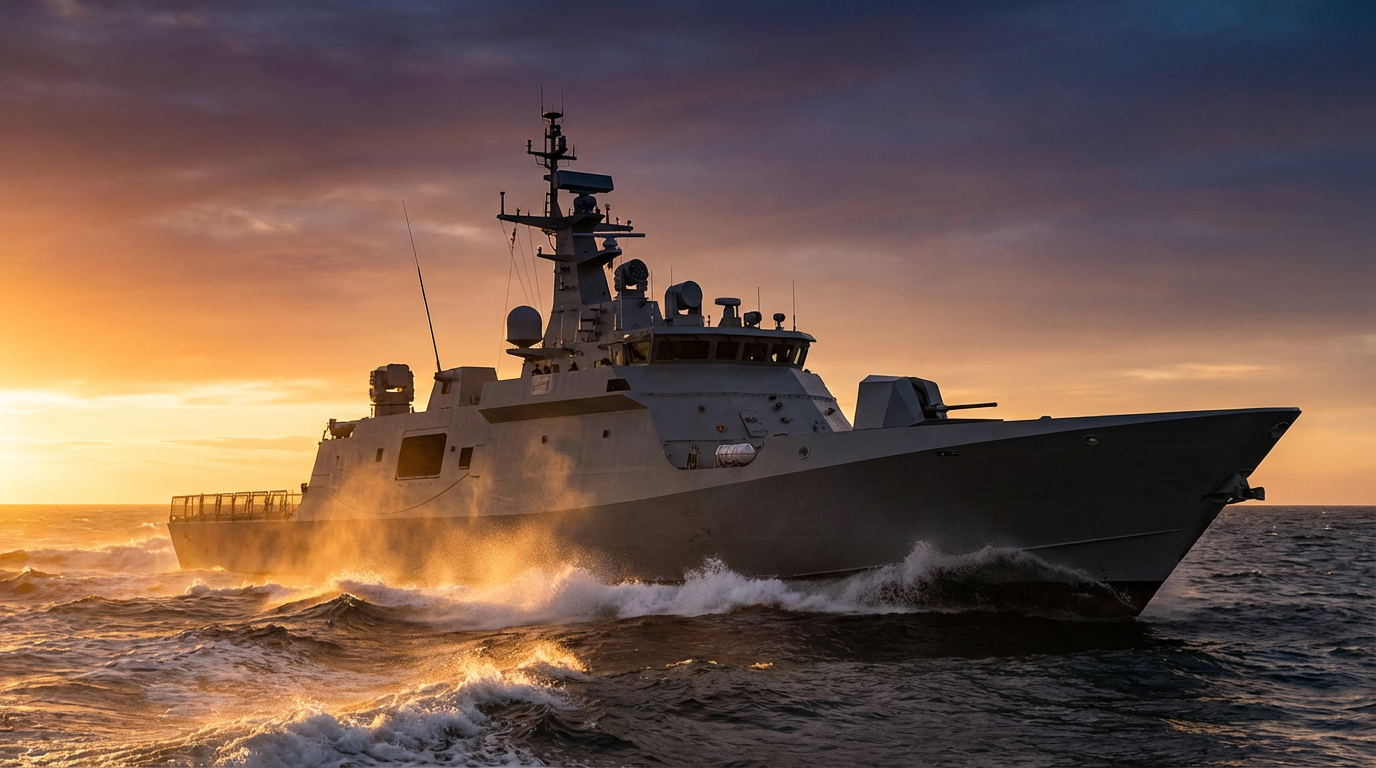
The Engineering Challenge: Deploying Data Center Compute at Sea
Objective: Deploying inference modules on vessels presents a specific set of environmental constraints that fail standard embedded systems.
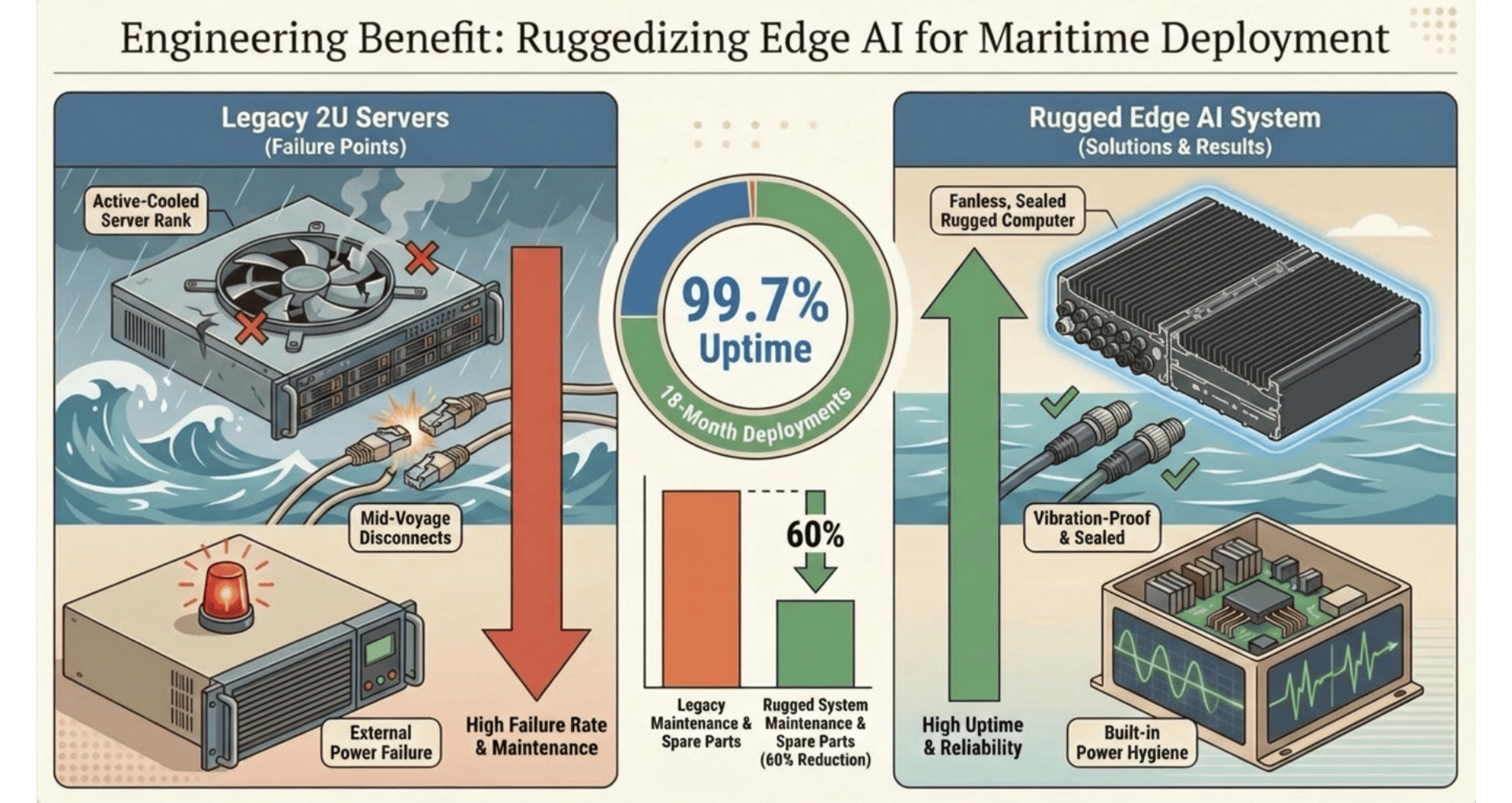
The primary failure points identified were:
- Corrosion & Signal Loss:High salinity and humidity degrade standard RJ45 and USB connectors, leading to intermittent signal loss in sensor arrays.
- Thermal Management:Running high-TDP accelerators (like the NVIDIA L4) in a sealed enclosure usually leads to thermal throttling.
- EMI Interference: Onboard radar and sonar systems generate significant electromagnetic interference, corrupting high-speed data transfer between the CPU and AI accelerators.
- Power Instability: Vessel generators create transient surges and voltage fluctuations that can reset or damage sensitive silicon.
Technical Solution: The SEMIL-2200GC Architecture
To address these root causes, the implementation utilized the Neousys SEMIL-2200GC, a fanless GPU computer designed for IP69K constraints.
1. Thermal Design for Sealed Enclosures
Instead of active air cooling (which pulls in moisture), the system uses a proprietary conduction-cooled chassis.
- Mechanism: Heat pipes transfer thermal load from the GPU and CPU directly to the external finned chassis.
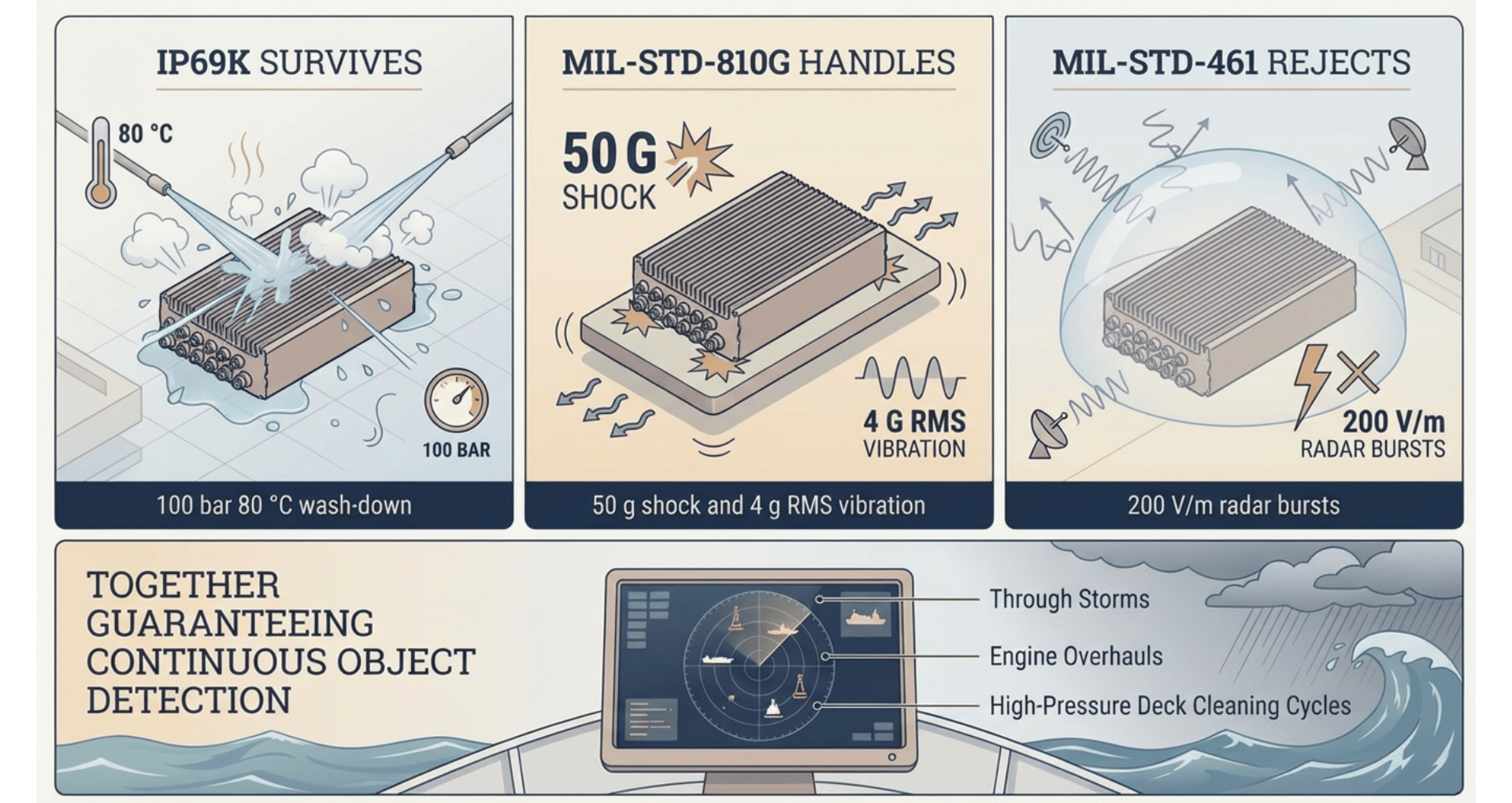
- Result: Sustained operation of the NVIDIA L4 GPU from -40°C to 70°C without throttling, preventing moisture ingress and condensation on FPGAs during rapid temperature shifts.
2. I/O Signal Integrity
Standard commercial connectors were replaced with M12 connectors.
- Benefit: These provide a screw-locking mechanism that is vibration-proof (MIL-STD-810G compliant) and fully sealed against salt fog, ensuring consistent data ingestion from sonar and optical sensors.
3. EMI and Power Isolation
- Shielding: The chassis design is MIL-STD-461 compliant, effectively shielding internal buses from external radar/sonar interference.
- Power Regulation: The wide-range DC input includes reverse polarity protection and isolation to filter out transient surges from the ship’s power grid, eliminating the need for external power conditioners.
System Specifications Summary
Why this matters: This architecture proves that data-center class inference can be moved to the extreme edge by addressing the physical layer (thermal, mechanical, electrical) rather than just software optimization.
Implementation Checklist: The "Go/No-Go" Assessment

Industrial IoT
We help you enable IIoT connectivity for operational efficiency and maximum business profits.
Knowledge Hub

Start your journey with Neteon!
Discover how our solutions can transform your business.
One click is all it takes.


Follow Us



Copyright © 2025 Neteon Technologies, Inc. All rights reserved.