

Solutions

Industries
Solutions

Industries

Connecting a Brownfield Food Plant with Advantech UNO-148 V2 Edge Computing

Neteon
December 2, 2026
Press Release

Deployment Takeaway
A brownfield food and beverage plant cannot stop its lines to replace every machine before it starts collecting data. The edge computer has to sit beside existing equipment, gather data from machines that were never designed to be connected, and keep processing at the line when the network drops.
Application Snapshot
Application: Real-time production, warehouse, and environmental data collection in food and beverage manufacturing.
Customer profile: A leading Italian food and beverage company with production facilities across the country (not named in the source).
Edge computer: Advantech UNO-148 V2 fanless DIN-rail edge controller.
Supporting devices: EKI-1221 Modbus gateways, WISE-6610 V2 LoRaWAN gateways, and WISE-4610 LoRaWAN wireless I/O modules.
Core workflow: Collect and process line data at the edge, bring legacy machines into SCADA and cloud platforms, monitor curing rooms and warehouse racks, and synchronize with MES and WMS.
Application source: Advantech's food and beverage case study.
Why the Company Modernized
According to Advantech, years of heterogeneous systems and legacy equipment without native connectivity had created inefficiencies, especially in the warehouse. Manual errors slowed picking and shipping, the lack of real-time data limited visibility across the supply chain, and batch traceability was limited in an industry where product quality and regulatory compliance are essential.
The company chose a brownfield approach: modernize the infrastructure by integrating and enhancing the systems already in place, rather than replacing existing assets.
What the System Needed
1. Continuous data collection at the line
The primary objective was reliable, continuous data collection. The edge node had to acquire information from multiple sources with low latency and keep working even during network interruptions.
2. A path for legacy machines
Older equipment communicated over RS-485 serial, not Ethernet. Those machines needed a way into SCADA environments and cloud platforms without being replaced.
3. Monitoring beyond the production line
Curing rooms require continuous control of temperature, humidity, and airflow, and the warehouse needed visibility of rack location occupancy. Both areas called for long-range, low-power wireless coverage.
4. Integration with business systems
Production and logistics data had to stay synchronized with the existing MES and WMS, and the company also needed quality control and predictive maintenance tools that detect anomalies early and minimize unplanned downtime.
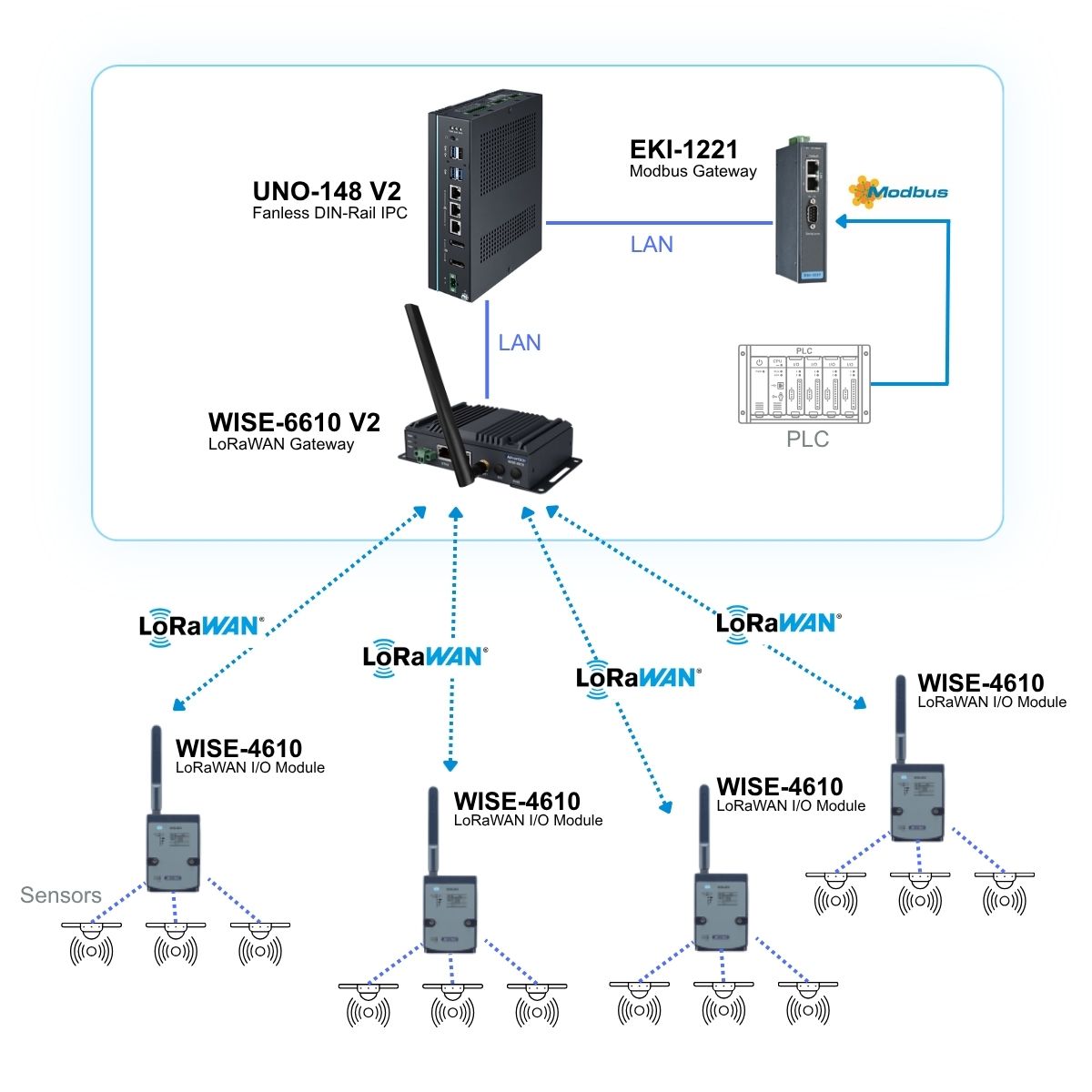
How the Architecture Works
Advantech describes a distributed architecture that connects the company's operational layers:
- UNO-148 V2 at the core: The primary node for data collection and online processing directly at the production line, maintaining operational continuity during network interruptions.
- EKI-1221 Modbus gateways: Convert RS-485 serial protocols to Ethernet, bringing older machines into SCADA and cloud platforms.
- WISE-6610 V2 and WISE-4610 over LoRaWAN: Monitor curing-room temperature, humidity, and airflow, plus warehouse rack occupancy, with long-range coverage and very low power consumption.
- MES and WMS integration: Keeps production and logistics information synchronized for more efficient handling of logistics operations.
Why the UNO-148 V2 Fit
The UNO-148 V2 is a fanless DIN-rail edge controller with 13th Gen Intel Core U-series processors, designed to work as a PC-based controller beside machinery. Its connectivity matches a brownfield plant:
- Field connections: Four isolated RS-232/422/485 serial ports and 8-channel isolated DI and 8-channel isolated DO for machines and sensors.
- Networking: Dual 2.5GbE ports with Time-Sensitive Networking support, plus a third Gigabit Ethernet port.
- Local storage: Dual M.2 2280 NVMe SSD slots with RAID support.
- Expansion: A full-size mPCIe slot, an M.2 E-key Wi-Fi slot, a SIM card slot, and Advantech iDoor modules for fieldbus, wireless, and I/O options.
Resulting Value
Advantech reports that order fulfillment times were reduced by up to 15–20% through more efficient picking and shipping, and operational errors decreased by 20–30%. Real-time data also gave the company a clearer, more complete view of the supply chain, supporting faster decisions and greater operational control.
Because legacy devices were integrated rather than replaced, the project contained investment costs, and edge processing reduced dependence on the cloud.
For plant and operations teams, the takeaway is that digitalization can start with the machines already on the floor: map which equipment speaks serial, which areas need wireless sensing, and where an edge computer should process data before it reaches MES, WMS, or the cloud.
How Neteon Supports Similar Projects
Neteon helps manufacturing and system-integration teams compare industrial computing platforms and review the configuration around the application. Share your machine count, serial and Ethernet interfaces, wireless coverage needs, and the systems your data has to reach with our IPC team before finalizing the hardware.
Explore the UNO-148 V2 Series at Neteon, or contact Neteon to discuss your project.
Manufacturer application story based on Advantech's published case study. Neteon offers related hardware selection and configuration support. Images courtesy of Advantech.
Recommended Products
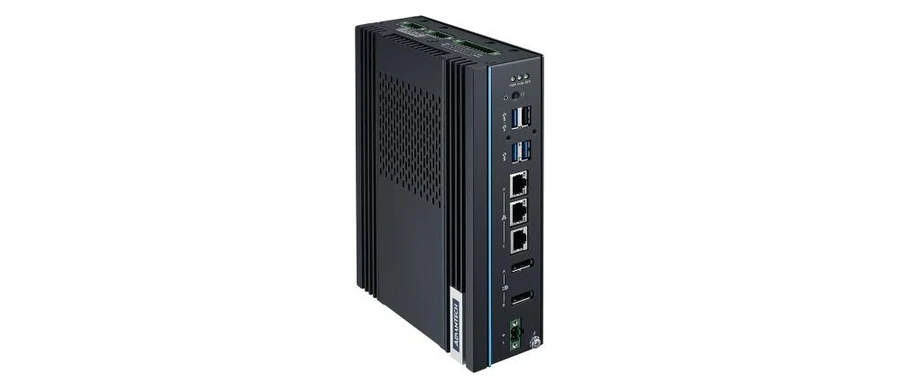
UNO-148-D33BA
Fanless DIN-rail edge controller with 13th Gen Intel Core i3-1315UE.
→View product info
UNO-148-D53BA
Fanless DIN-rail edge controller with 13th Gen Intel Core i5-1335UE.
→View product info
UNO-148-D73BA
Fanless DIN-rail edge controller with 13th Gen Intel Core i7-1365UE.
→View product info

→View product info
→View product info
→View product info


Industrial IoT
We help you enable IIoT connectivity for operational efficiency and maximum business profits.
Knowledge Hub

Start your journey with Neteon!
Discover how our solutions can transform your business.
One click is all it takes.


Follow Us



Copyright © 2025 Neteon Technologies, Inc. All rights reserved.