TL;DR
PROFINET, EtherNet/IP, and Modbus TCP are the three dominant industrial Ethernet protocols, each with distinct architectures, real-time capabilities, and regional adoption patterns. This guide compares their technical specifications, use cases, and interoperability considerations to help engineers select the right protocol — or manage multi-protocol environments.
The Industrial Ethernet Landscape
Industrial Ethernet has displaced legacy fieldbus protocols (Profibus, DeviceNet, CC-Link) as the dominant communication layer in manufacturing and process automation. By 2025, industrial Ethernet accounts for 68% of new industrial network installations (HMS Networks). Three protocols dominate:
| Protocol | Developer | Market Share | Primary Region |
|---|---|---|---|
| PROFINET | Siemens / PI | 21% | Europe, China |
| EtherNet/IP | ODVA / Rockwell | 17% | Americas |
| Modbus TCP | Modbus.org / Schneider | 11% | Global (legacy) |
| OPC UA | OPC Foundation | Growing | Cross-platform |
Understanding these protocols is essential for network engineers designing multi-vendor industrial systems.
PROFINET: Real-Time Determinism
PROFINET (Process Field Network) was developed by Siemens and the PROFINET International organization. It operates at Layer 2, bypassing the TCP/IP stack for deterministic real-time communication.
Three conformance classes:
| Class | Real-Time Level | Cycle Time | Use Case |
|---|---|---|---|
| CC-A | RT (Real-Time) | 1-10 ms | Standard I/O, monitoring |
| CC-B | RT with redundancy | 1-10 ms | Process automation, diagnostics |
| CC-C | IRT (Isochronous RT) | <1 ms (31.25 μs min) | Motion control, servo drives |
Key characteristics: - Layer 2 communication for time-critical data (no TCP/IP overhead) - Supports standard TCP/IP traffic simultaneously on the same wire - Provider/consumer model with cyclic and acyclic communication - Integrated diagnostics with alarm and event handling - Dominant in Siemens S7 PLC environments
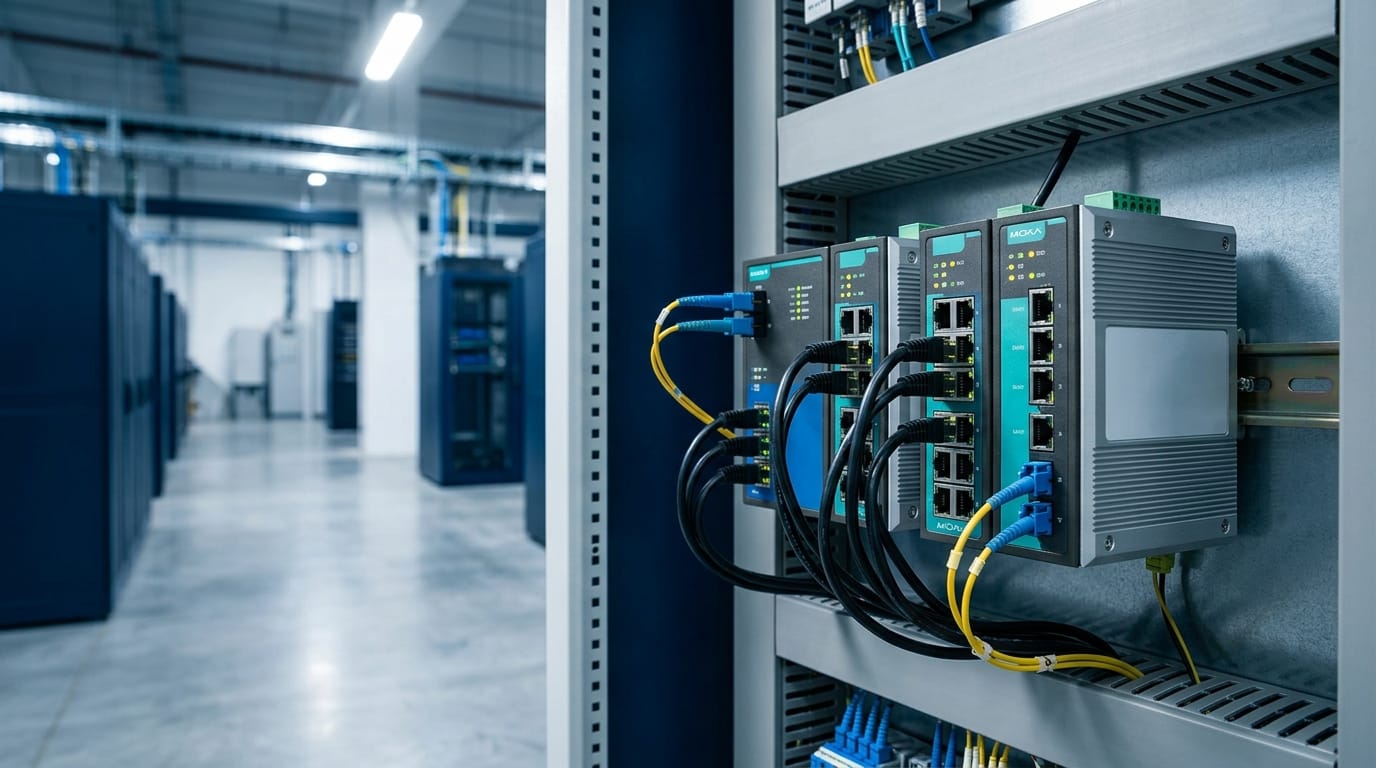
Network requirements for PROFINET: - Managed switches with PROFINET conformance (CC-B minimum) - IEEE 1588 PTP support for IRT applications - Moxa EDS-400A Series provides PROFINET CC-B compliance with Turbo Ring redundancy
EtherNet/IP: CIP Over Standard Ethernet
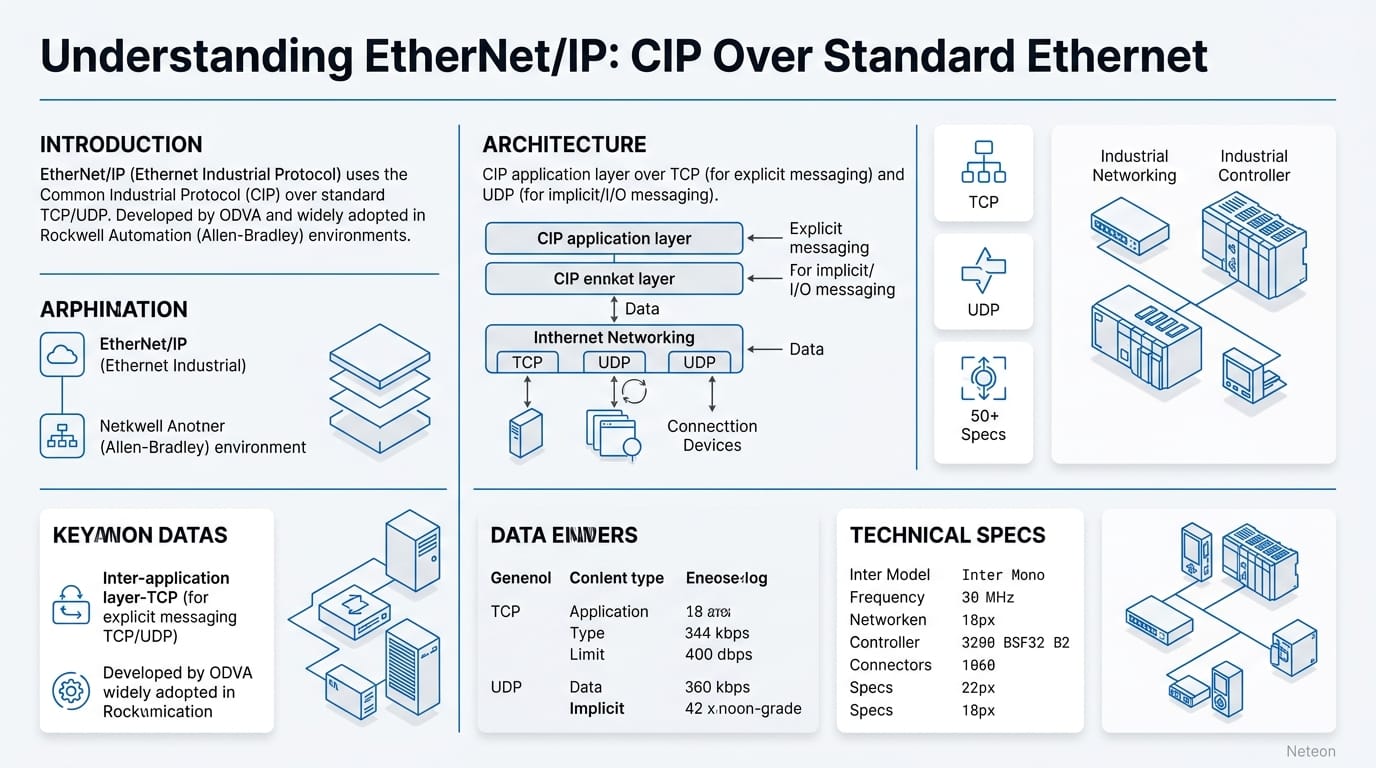
EtherNet/IP (Ethernet Industrial Protocol) uses the Common Industrial Protocol (CIP) over standard TCP/UDP. Developed by ODVA and widely adopted in Rockwell Automation (Allen-Bradley) environments.
Architecture: - CIP application layer over TCP (explicit messaging) and UDP (implicit/I/O messaging) - Producer/consumer model with multicast I/O updates - Standard TCP/IP stack — no special switch requirements for basic operation - CIP Safety for SIL 3 functional safety communication - CIP Security for TLS-based device authentication and encryption
| Feature | Specification |
|---|---|
| I/O Update Rate | 0.5 ms - 10 ms typical |
| Max Devices | 65,535 per subnet (theoretical) |
| Topology | Star, ring, linear (DLR) |
| Multicast | UDP multicast for I/O data |
| Safety | CIP Safety (SIL 3) |
| Security | CIP Security (TLS, DTLS) |
Network requirements for EtherNet/IP: - IGMP snooping on switches (essential for multicast management) - QoS for I/O traffic prioritization - DLR (Device Level Ring) support for ring topology at device level - Managed switches recommended for networks >20 devices
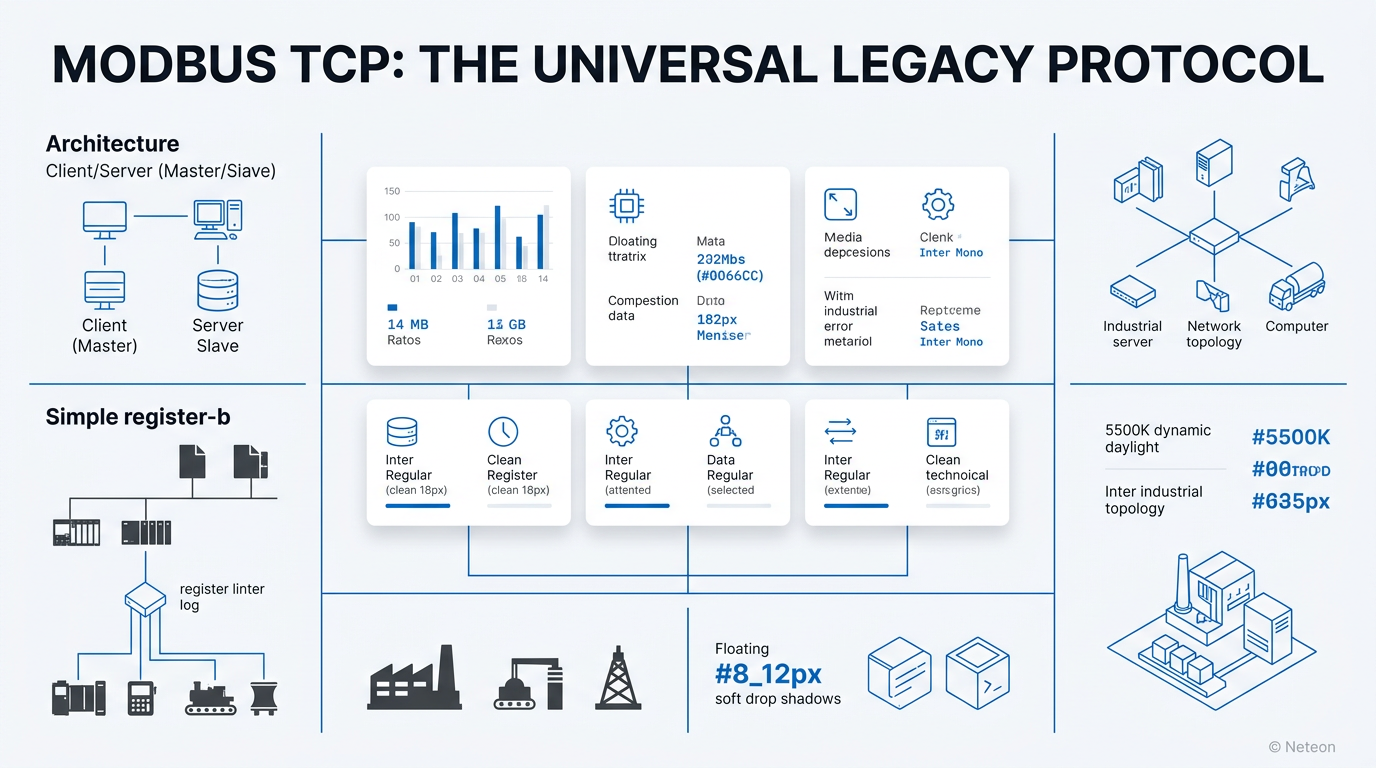
Modbus TCP: The Universal Legacy Protocol
Modbus TCP is the simplest and most widely understood industrial protocol. Originally developed by Modicon (now Schneider Electric) in 1979 as Modbus RTU for serial communication, the TCP variant runs over standard Ethernet.
Architecture: - Client/server (master/slave) model - Simple register-based data model (coils, discrete inputs, holding registers, input registers) - Standard TCP on port 502 - No built-in security (zero authentication, zero encryption)
| Feature | Specification |
|---|---|
| Transport | TCP port 502 |
| Data Model | 16-bit registers, binary coils |
| Max Data/Message | 252 bytes (125 registers) |
| Authentication | None (by design) |
| Encryption | None (by design) |
| Real-Time | Not deterministic |
Why Modbus TCP persists: - Extreme simplicity — any device can implement it - Universal support — virtually every PLC, RTU, and HMI supports Modbus - Low overhead — minimal bandwidth requirements - Protocol gateways bridge Modbus to modern protocols
Security concern: Modbus TCP's lack of authentication makes it a prime target for protocol-level attacks. Industrial firewalls with Modbus DPI (Moxa EDR-G9010) can validate function codes and register ranges to prevent unauthorized commands.
Protocol Comparison
| Criteria | PROFINET | EtherNet/IP | Modbus TCP |
|---|---|---|---|
| Real-Time | Deterministic (IRT <1ms) | Soft real-time (0.5-10ms) | Non-deterministic |
| Complexity | High | Medium | Low |
| Switch Requirements | PROFINET-aware managed | IGMP snooping recommended | Any Ethernet switch |
| Security | Zone-based, TLS coming | CIP Security (TLS) | None built-in |
| Diagnostics | Integrated alarms | CIP diagnostics | Basic exception codes |
| PLC Ecosystem | Siemens | Rockwell, ODVA members | Universal |
| Interoperability | PROFINET devices only | CIP devices only | Virtually everything |
| Migration Path | PROFINET over TSN | EtherNet/IP over TSN | OPC UA, MQTT |
Managing Multi-Protocol Networks
Most industrial facilities run multiple protocols simultaneously. A typical plant might use PROFINET for Siemens PLC cells, EtherNet/IP for Rockwell lines, and Modbus TCP for building automation and legacy equipment.
Strategy 1: Protocol Gateways Moxa MGate Series protocol gateways translate between protocols at the application layer (e.g., Modbus TCP ↔ EtherNet/IP, Modbus RTU ↔ PROFINET).
Strategy 2: Unified Backbone with Protocol-Specific Segments Use a managed industrial Ethernet backbone with VLAN segmentation, routing protocol-specific traffic to dedicated segments.
Strategy 3: OPC UA Integration Layer Deploy OPC UA as a cross-protocol integration layer at the MES/SCADA level, collecting data from all protocols through OPC UA wrappers.
Cybersecurity & Reliability
| Protocol | Security Risk | Mitigation |
|---|---|---|
| PROFINET | Limited native security | Managed switches with ACLs, VLAN isolation |
| EtherNet/IP | Multicast exposure | IGMP snooping, CIP Security where supported |
| Modbus TCP | No auth/encryption | DPI firewall (EDR-G9010), function code filtering |
| All Protocols | Lateral movement risk | IEC 62443 zone segmentation |
Related Products
Product cards auto-generated by shopmoxa_scraper.py
Conclusion
Protocol selection depends primarily on the PLC ecosystem and real-time requirements of your application. For greenfield designs, consider the migration path to TSN (Time-Sensitive Networking), which both PROFINET and EtherNet/IP are adopting. For multi-protocol environments, protocol gateways and managed switches with VLAN segmentation provide seamless interoperability. Contact Neteon for protocol-specific network design guidance.
Frequently Asked Questions
Q: Which industrial Ethernet protocol should I choose for a new installation? A: Match the protocol to your PLC ecosystem: PROFINET for Siemens, EtherNet/IP for Rockwell/Allen-Bradley. For multi-vendor or simple applications, EtherNet/IP's standard TCP/IP approach offers the broadest compatibility.
Q: Can PROFINET and EtherNet/IP coexist on the same switch? A: Yes. Both use standard Ethernet frames, so a managed switch with VLAN segmentation can carry both protocols on separate VLANs. The switch must support PROFINET conformance for PROFINET traffic and IGMP snooping for EtherNet/IP multicast.
Q: Is Modbus TCP still relevant in 2026? A: Yes. Its simplicity and universal support make it the default for building automation, power metering, environmental monitoring, and legacy system integration. However, new safety-critical applications should use protocols with built-in security.
Q: What is TSN and will it replace current protocols? A: Time-Sensitive Networking (IEEE 802.1 TSN) provides deterministic Ethernet at the switch level. PROFINET over TSN and EtherNet/IP over TSN are in development. TSN will not replace these protocols but will provide a unified real-time Ethernet layer beneath them.
Q: How do protocol gateways affect latency? A: Moxa MGate protocol gateways typically add 5-15ms latency for protocol translation. This is acceptable for monitoring and non-time-critical data exchange but not suitable for real-time motion control. For time-critical applications, use native protocol communication.