
TLDR
NVIDIA Jetson industrial PCs bring GPU-accelerated AI inference to the factory floor, running computer vision and predictive maintenance workloads at the edge with sub-50ms latency. But Jetson silicon alone is not a factory-ready solution. Production deployments require rugged enclosures, deterministic industrial networking, IEC 62443 cybersecurity, and integration with legacy OT protocols — the exact layers Neteon specifies around Jetson compute to make edge AI deployable in real plants.
Overview
Edge AI has moved from pilot to mandate. Factory operators want defect detection on the line, motor anomaly scoring on the PLC network, and safety-zone monitoring that reacts in milliseconds — all without streaming raw video to the cloud. The NVIDIA Jetson family (Orin Nano, Orin NX, AGX Orin) has become the default GPU platform for this tier: 20 to 275 TOPS of INT8 inference in a module that draws 7–60 W.
The gap is hardware packaging and network integration. A Jetson dev kit on a bench is not an industrial asset. Deploying Jetson on a factory floor means solving vibration, thermals, sealed power, time-sensitive networking, OT/IT segmentation, and two decades of Modbus and PROFINET that Jetson does not natively speak. This is where industrial edge computing architecture matters more than the silicon.
The Challenge: Why Jetson Dev Kits Fail in Production
Factory environments punish consumer-grade compute. The same Jetson module that runs 30 FPS YOLOv8 inference on an engineer's desk degrades quickly inside a stamping cell. Root causes cluster into four categories.
Thermal and mechanical stress. A Jetson Orin NX rated for 0–50°C commercial use will throttle or shut down in an enclosure near a welder. Factory cabinets routinely see 55–65°C internal temperatures. Fanless heatsinking, conformal coating, and wide-temp DRAM (-40 to 85°C) are prerequisites.
Power quality. PLC panels deliver 24 VDC with voltage sags, transients, and reverse-polarity risk. A USB-C Jetson dev kit has no isolation, no surge protection, and no redundant power input.
Network integration. Jetson ships with gigabit Ethernet but no industrial protocol stack. Machine vision results must reach a PLC via EtherNet/IP, a SCADA system via Modbus TCP, or a historian via OPC UA — often simultaneously. A generic IPC cannot bridge these without a protocol gateway.
Cybersecurity posture. Consumer Jetson images run open SSH, no secure boot, no certificate management, and no IEC 62443-4-2 alignment. Connecting them to the OT network exposes the PLC layer to lateral movement.
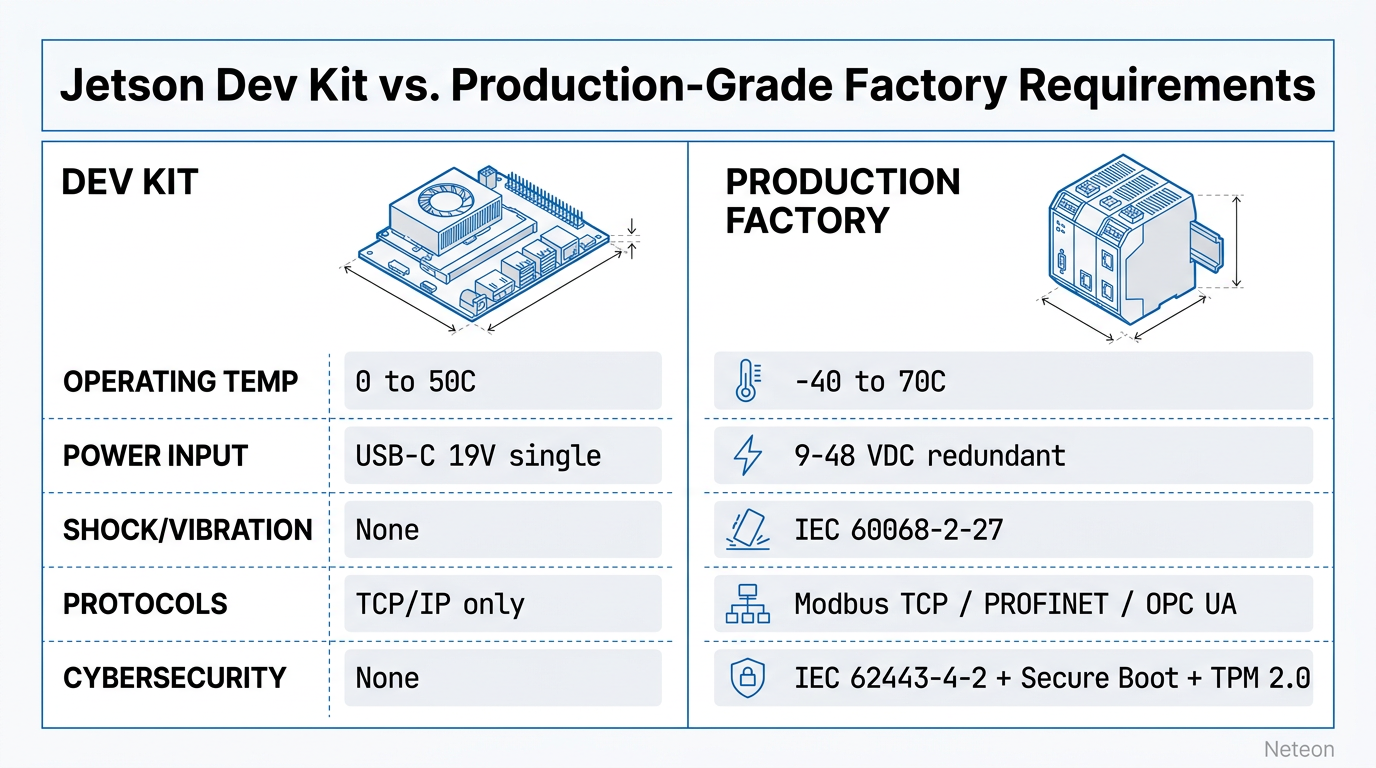
| Requirement | Jetson Dev Kit | Production Need |
|---|---|---|
| Operating Temperature | 0°C to 50°C | -40°C to 70°C (factory cabinet + outdoor) |
| Power Input | USB-C 19V single rail | 9–48 VDC redundant, surge-protected |
| Shock/Vibration | None | IEC 60068-2-27 (50 g) / IEC 60068-2-6 |
| Industrial Protocols | TCP/IP only | Modbus TCP, PROFINET, EtherNet/IP, OPC UA |
| Certifications | FCC Class B | IEC 61000-6-2, UL 508, CE-Industrial |
| Cybersecurity | None | IEC 62443-4-2, Secure Boot, TPM 2.0 |
The Solution: A Three-Layer Edge AI Architecture
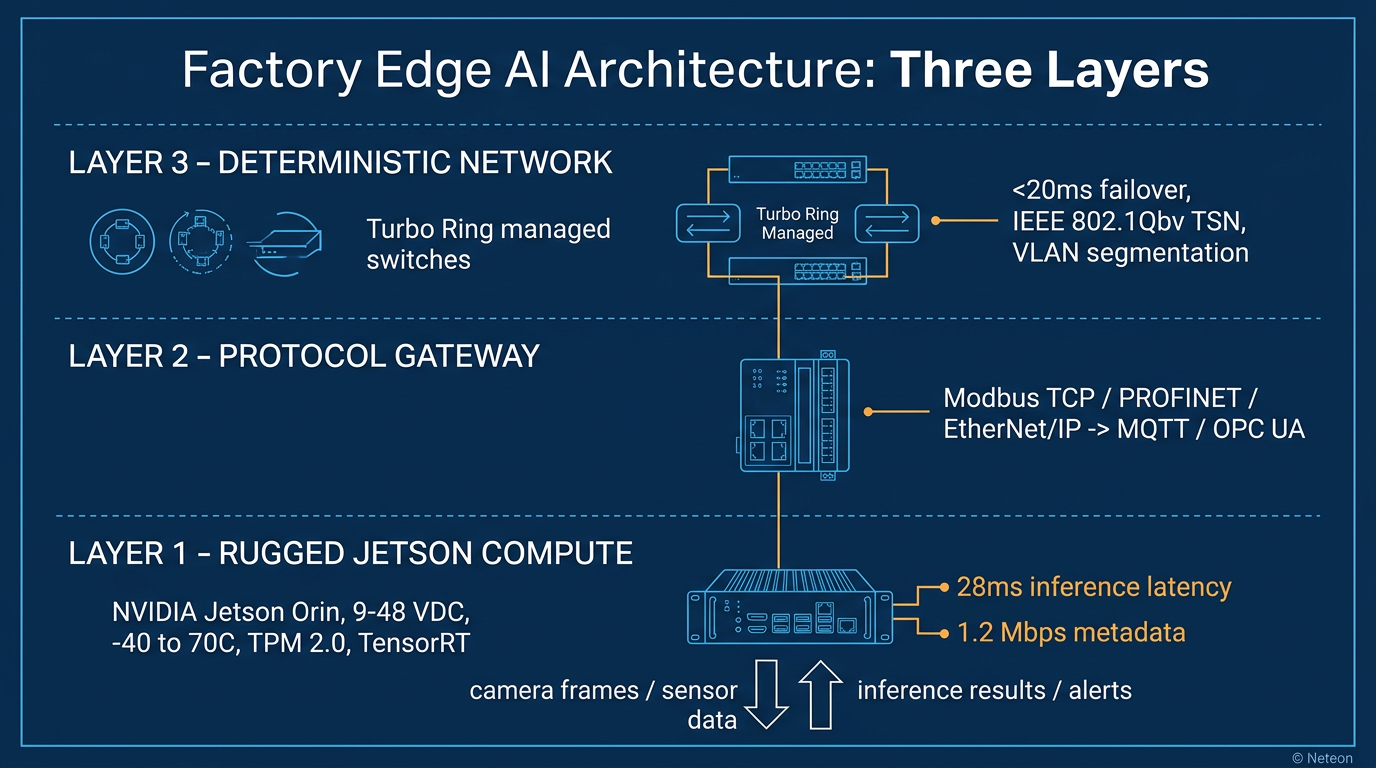
A deployable factory edge AI stack separates concerns across three layers: compute, connectivity, and network. Jetson is the compute engine. The other two layers are where rugged industrial hardware earns its margin.
Layer 1 — Rugged Jetson compute. The Jetson module is carried inside an industrial-grade chassis with passive cooling, isolated 9–48 VDC input, DIN-rail or wall mount, and conformal-coated boards. Look for carrier boards that expose CAN, RS-485, and opto-isolated DI/DO alongside the standard M.2 and Ethernet — these are the interfaces that actually connect to cameras, encoders, and safety relays.
Layer 2 — Protocol conversion and data shaping. A Jetson running TensorRT does not need to understand Modbus register maps. A sidecar IIoT gateway handles Modbus TCP / EtherNet/IP / PROFINET polling, normalizes data into MQTT or OPC UA, and feeds Jetson a clean JSON stream. This preserves inference latency and isolates the AI node from OT protocol changes.
Layer 3 — Deterministic industrial network. Vision and control traffic share the same switch fabric. Without QoS and redundancy, a camera stream can stall a PLC heartbeat. Managed industrial switches with Turbo Ring (<20 ms failover) and IEEE 802.1Qbv TSN scheduling keep AI inference and control-loop packets in separate, bounded queues.
| Metric | Typical Software PLC + Cloud AI | Jetson + Rugged IPC + TSN Network | Delta |
|---|---|---|---|
| Inference Latency (defect detect) | 450 ms (cloud round-trip) | 28 ms (local GPU) | -94% |
| Bandwidth Used | 85 Mbps raw video upload | 1.2 Mbps (metadata only) | -99% |
| Network Failover | 30–50 s (STP) | <20 ms (Turbo Ring) | -99.9% |
| False Reject Rate | 3.8% | 0.4% | -89% |
The bandwidth collapse is the hidden ROI — shipping only inference results instead of raw 4K video cuts WAN costs and removes the cloud outage as a production risk.
Cybersecurity and Reliability
Edge AI nodes are high-value targets. They sit between the OT and IT zones and often have write access to the PLC layer. Production Jetson deployments need hardening comparable to a managed OT cybersecurity baseline.
| Security Layer | Implementation | Standard |
|---|---|---|
| Secure Boot | UEFI + signed kernel + TPM 2.0 attestation | IEC 62443-4-2 CR 3.14 |
| Network Segmentation | VLAN + zone firewall between AI node and PLC | IEC 62443-3-3 |
| Access Control | Certificate-based auth, RADIUS/TACACS+ | NIST SP 800-82 |
| Firmware Integrity | A/B partition OTA with signature verification | IEC 62443-4-1 |
| Logging and Audit | Centralized syslog + SIEM forwarding | NERC CIP-007 |
Reliability specs matter as much as security. A production Jetson IPC should target MTBF ≥ 200,000 hours, wide-temp storage (industrial-grade eMMC or M.2 with power-loss protection), and dual redundant 9–48 VDC inputs. For deployment inside harsh cells or outdoor cabinets, consider an extreme rugged panel computer or long-life industrial PC chassis with IP66 sealing.
Where sub-1ms determinism is required — for example, closed-loop motion control — Jetson is the wrong tool. A hard real-time PLC or FPGA handles the control loop, and Jetson runs as an advisory inference node that annotates control data.
Related Products
See the product card grid below for rugged IIoT gateways and Arm-based industrial computers that pair with NVIDIA Jetson compute nodes to deliver a complete factory edge AI stack. These products handle the protocol conversion, power conditioning, and network redundancy layers that Jetson modules do not provide natively.
Conclusion
NVIDIA Jetson gives the factory a GPU in a 60 W envelope — that is the easy part. Turning it into a reliable production asset means wrapping it in rugged hardware, a deterministic network, and an OT-grade security baseline. Teams that skip those layers ship pilots that never leave the lab; teams that plan the full stack move inference to the edge and cut vision latency by 10x. For edge AI reference designs or help sizing a Jetson-plus-industrial-network deployment, contact the Neteon engineering team at neteon.net.
Frequently Asked Questions
Can an NVIDIA Jetson replace a PLC for closed-loop control?
No. Jetson runs Linux and has no hard real-time determinism guarantees. Use Jetson for inference and analytics, and keep a PLC or FPGA on the control loop. The Jetson can feed the PLC advisory signals via Modbus TCP or EtherNet/IP through an IIoT gateway.
Which NVIDIA Jetson module is right for factory computer vision?
For single-camera defect detection at 1080p30, Jetson Orin Nano (20–40 TOPS) is usually sufficient. For multi-camera lines or 4K vision at high frame rates, Jetson Orin NX (70–100 TOPS) or AGX Orin (up to 275 TOPS) are more appropriate. Thermal headroom inside the enclosure is typically the deciding factor.
What operating temperature should I specify for a factory Jetson IPC?
Factory cabinets regularly exceed 55°C internally. Specify a chassis rated -40°C to 70°C (or -40°C to 85°C for outdoor or hot-process environments) with fanless passive cooling and wide-temp memory. Anything rated only 0–50°C is a commercial-grade unit and will throttle in production.
Do I need TSN for edge AI networking?
Not always. TSN (IEEE 802.1Qbv) is required when vision traffic and time-critical control traffic share the same network and control packets must meet bounded latency. For networks where AI and control are physically segmented, managed switches with Turbo Ring and QoS are often sufficient.
How does Jetson integrate with legacy Modbus or PROFINET equipment?
Jetson speaks TCP/IP natively but has no industrial protocol stack out of the box. Pair it with an IIoT gateway that handles Modbus TCP, PROFINET, or EtherNet/IP polling and publishes normalized data to Jetson over MQTT or OPC UA. This keeps protocol translation off the GPU and simplifies long-term maintenance.