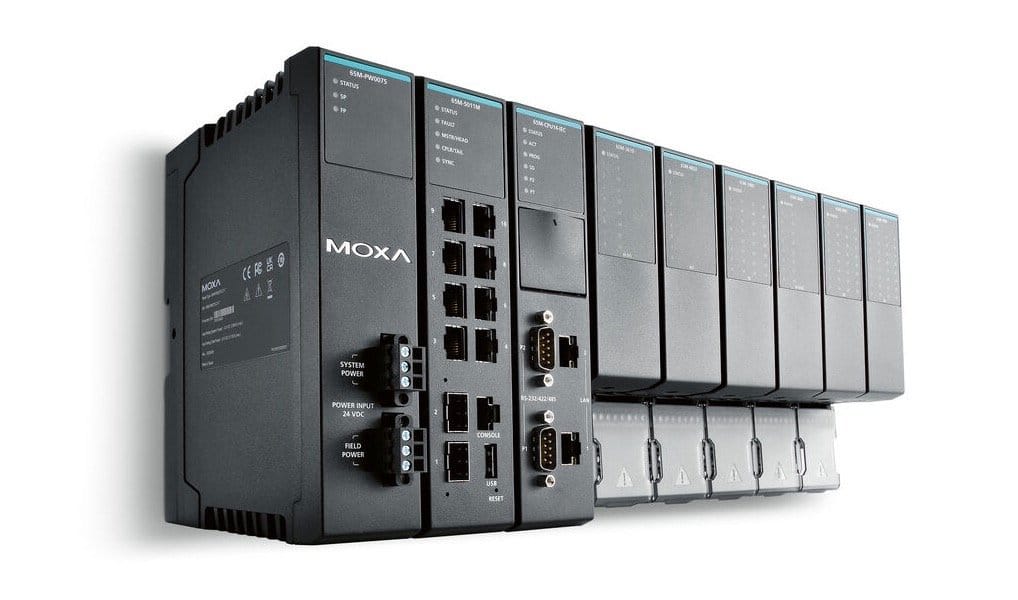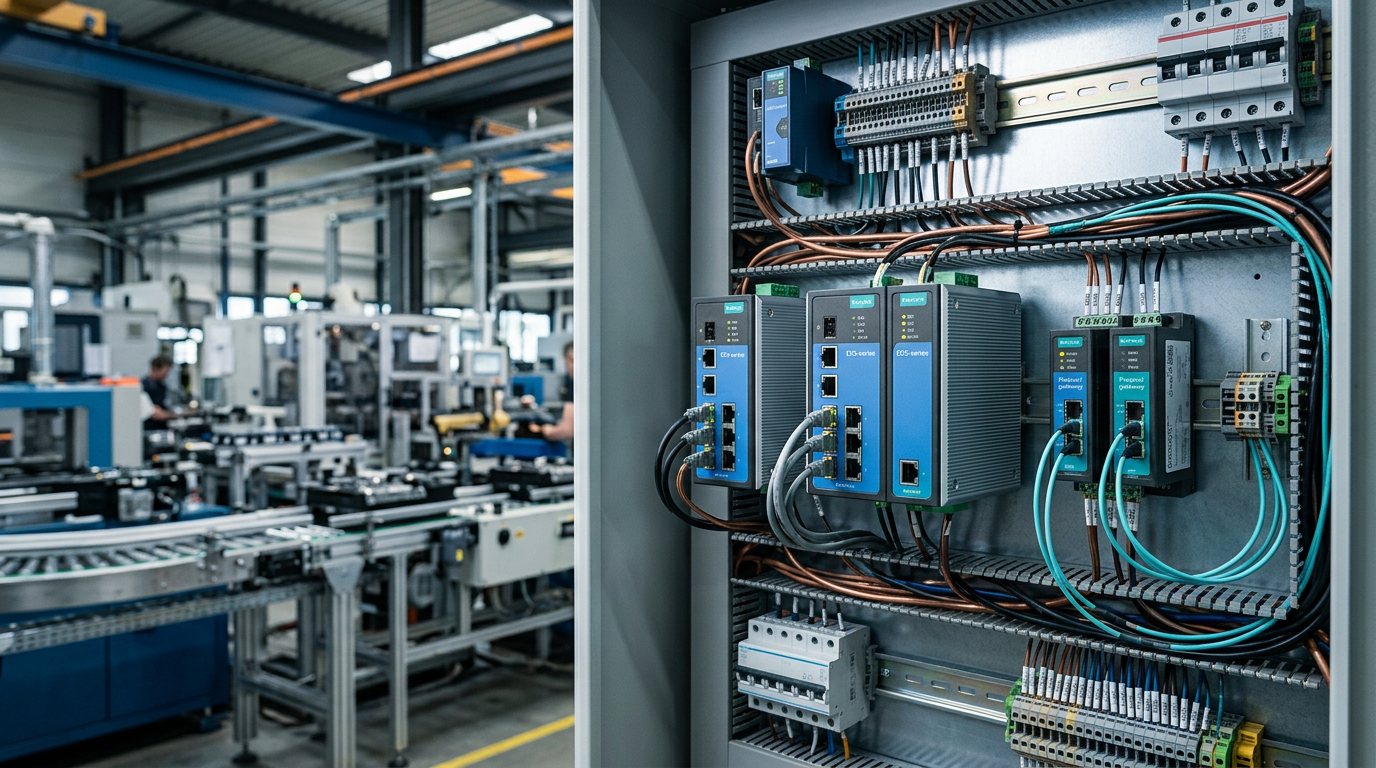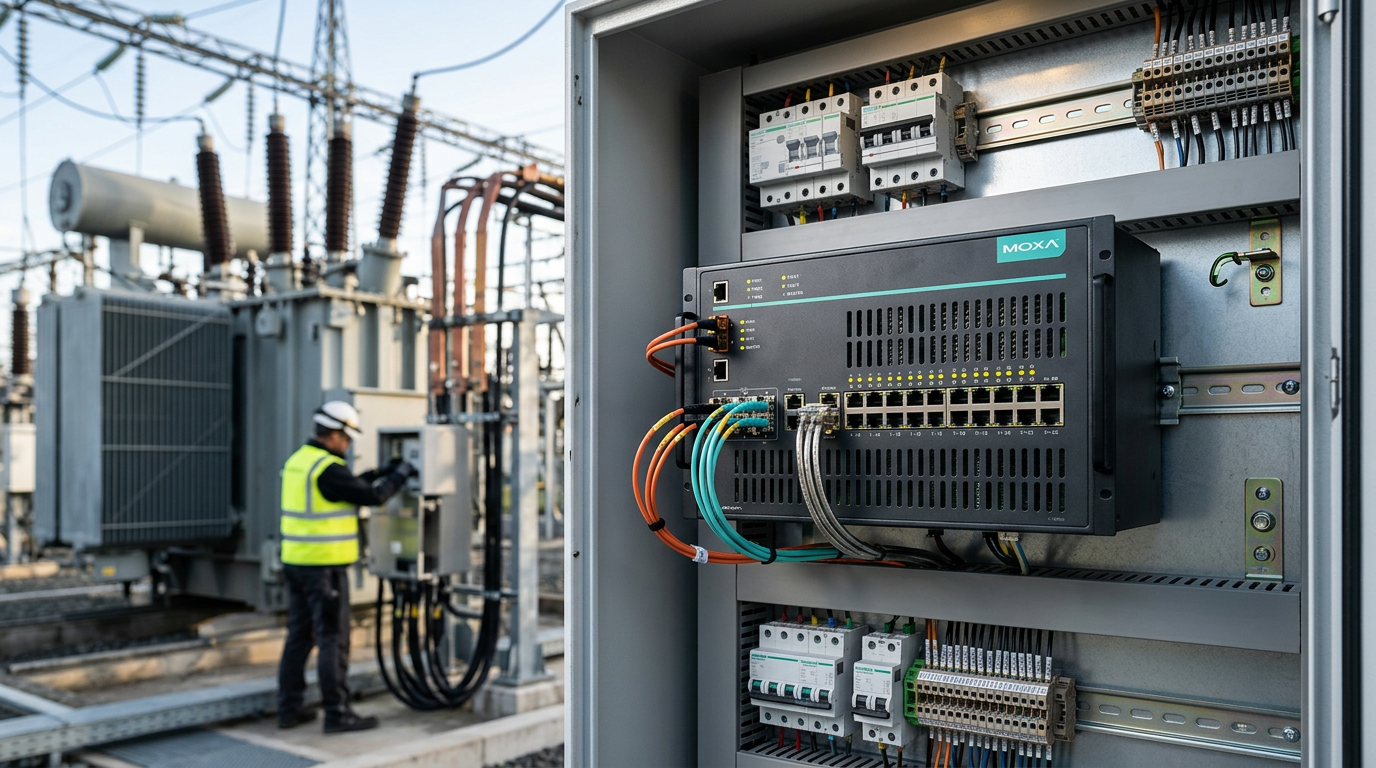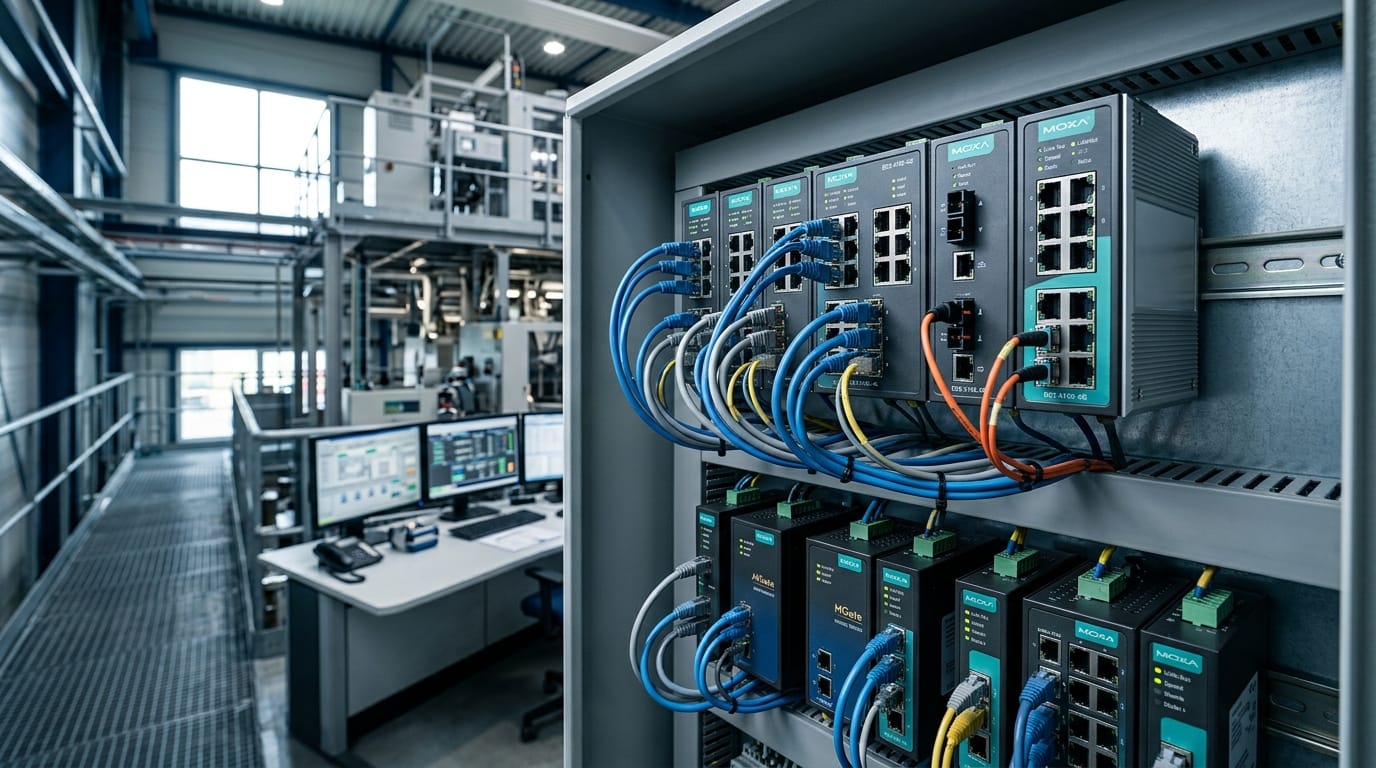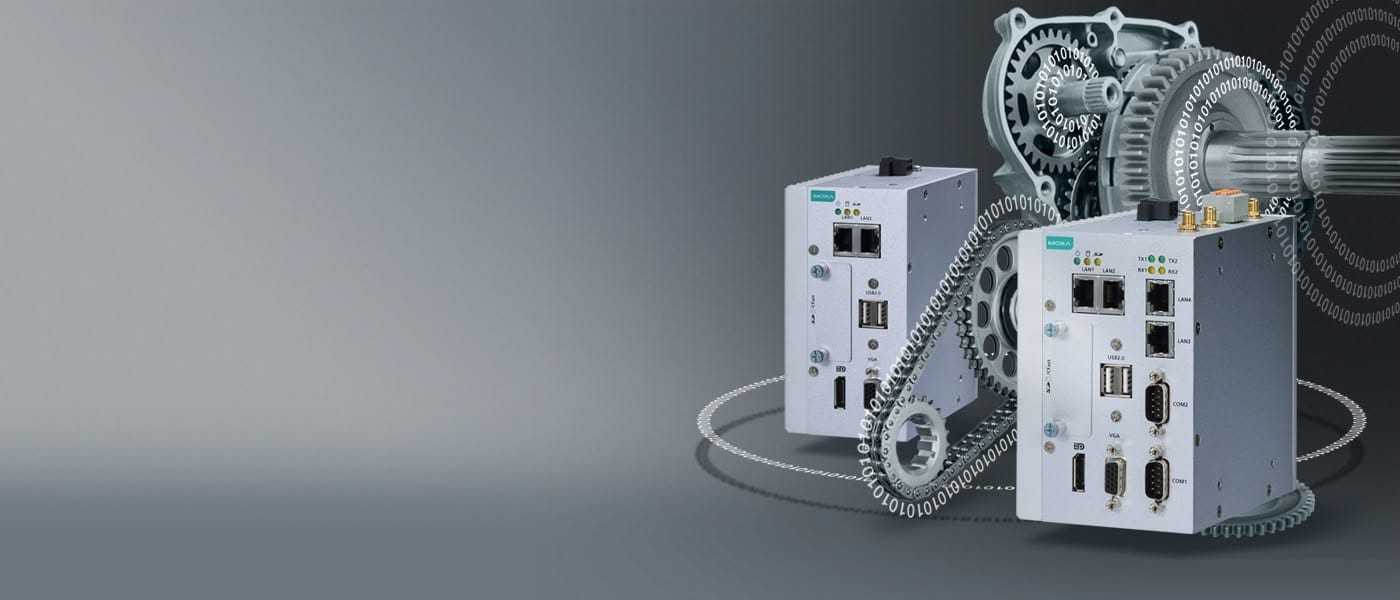
A DIN-rail computer is an industrial PC built to clip directly onto a DIN rail — the standardized 35mm "top-hat" metal mounting rail (EN 60715 / DIN 46277) that runs along the back of nearly every control cabinet and electrical enclosure. Instead of a desktop tower or a 19" rackmount chassis, the computer snaps onto the same rail as your PLCs, circuit breakers, terminal blocks, relays, and power supplies.
Mechanically they share a common design language: compact and narrow (to conserve rail width), fanless (no moving parts to fail or clog in dusty/oily environments), wide DC power input (typically 9–48 VDC), and ruggedized for wide temperature, shock, and vibration. The trade-off versus a box/panel PC is constrained internal volume — limited expansion, modest thermal headroom, and fewer drive bays.
Why it matters in the Industrial PC space
The DIN-rail form factor occupies a specific and growing niche between two extremes — the small embedded gateway and the full box/rackmount IPC:
- Cabinet real estate is scarce and expensive. Mounting compute on the same rail as the control gear avoids dedicated shelving or separate enclosures. This is the single biggest practical driver.
- It sits where the data is. Placing compute next to the PLC and field I/O is the natural home for edge computing — protocol conversion, local analytics, data buffering, and OT/IT gatewaying — without backhauling raw data to a server room.
- Serviceability. A technician can swap a unit off the rail in seconds without unbolting a chassis. That lowers MTTR in 24/7 operations.
- Environmental survivability. Fanless, wide-temp (-40 to 70/85°C on "T" variants), and conformal-coated options let it live in substations, roadside cabinets, water/wastewater stations, and offshore enclosures where a commercial PC wouldn't last.
- Standards and safety. Hazardous-location ratings (Class 1 Div 2, ATEX Zone 2) and EMC compliance let it deploy in oil & gas, mining, and energy without separate explosion-proof housings.
The limitation to be honest about: when you need heavy GPU/AI inference, lots of PCIe expansion, or high storage capacity, a DIN-rail unit usually isn't the right tool — a box PC or rackmount is. DIN-rail wins on space, ruggedness, and cabinet integration, not raw horsepower.
How Moxa's product lines fit
Moxa splits its DIN-rail computers along two axes — Arm (UC series) for low-power gateway/edge roles, and x86 (MC, V, DRP series) for Windows/heavier-compute roles. Here's how the families that Neteon carries map to use cases:
| Series | Architecture | Typical role | Notes |
|---|---|---|---|
| UC-1200/2200 (UC-1222A, UC-2222A) | Arm Cortex-A53 | Compact edge gateway, protocol bridging | TPM, Linux pre-installed; -T variants wide-temp; -US adds built-in LTE |
| UC-3100 (UC-3111) | Arm | Cellular IIoT gateway | Built-in LTE + Wi-Fi for remote/unmanned sites |
| UC-5100 (UC-5101, UC-5111) | Arm | Serial-heavy field data concentration | 4 serial ports + 2 LAN + DI/DO — legacy device aggregation |
| UC-8200/8400 (UC-8220, UC-8410A) | Arm | Multi-interface IIoT computing | mPCIe expansion, CAN, more I/O |
| MC-1100 (MC-1112) | x86 Atom | Rugged fanless x86 in harsh sites | C1D2 / ATEX, -40 to 70°C, Azure IoT certified |
| MC-1220 | x86 Core i7 | Higher-performance x86 edge | Up to i7-7600U, 16 GB RAM, C1D2/ATEX |
| V2201 | x86 Atom | Ultra-compact x86 with dual wireless | Two mini-PCIe slots for radios |
| DRP-C100 | x86 Celeron/i5/i7 | Modern modular DIN-rail edge platform | 11th-gen Intel, configurable LAN/COM (e.g. 10× LAN or 8× COM variants), Win10 options |
A useful way to think about selection: start with whether you need x86 (Windows apps, heavier compute) or Arm (low power, fanless, gateway-class). Then layer in environment (wide-temp "T" models, hazardous-location ratings), connectivity (serial count, LAN count, built-in cellular), and expansion (mPCIe slots). The newer DRP-C100 line is Moxa's flagship for x86 edge — it's the one to lead with when a customer wants current-generation Intel performance plus port flexibility in a DIN-rail footprint, whereas the UC series is the answer for distributed, low-power gateway deployments.
Want me to turn any of this into a comparison piece, a buyer's decision guide for the Neteon site, or a case-study-style article around a specific DIN-rail deployment?