TL;DR
Industrial network redundancy protocols vary from 30+ second recovery (STP) to zero-loss failover (PRP/HSR). Turbo Ring provides <20ms recovery with up to 250 switches — the optimal balance of speed, scalability, and cost for most industrial applications. This comparison helps engineers select the right protocol based on recovery time requirements, topology constraints, and interoperability needs.
Why Redundancy Matters in Industrial Networks
A network failure in a commercial office means someone cannot check email. A network failure in a manufacturing plant means a $50,000/hour production line stops. In a power substation, it means a protection relay loses visibility. In a railway signaling system, it triggers an emergency stop.
Industrial networks demand quantified availability:
| Availability | Downtime/Year | Typical Application |
|---|---|---|
| 99.9% | 8.76 hours | Office networks |
| 99.99% | 52.6 minutes | Standard manufacturing |
| 99.999% | 5.26 minutes | Critical manufacturing, utilities |
| 99.9999% | 31.5 seconds | Safety systems, substations |
Achieving 99.999%+ requires network redundancy protocols with sub-second failover.
Protocol Comparison
| Protocol | Standard | Recovery Time | Max Ring Size | Topology | Multi-Vendor |
|---|---|---|---|---|---|
| STP | IEEE 802.1D | 30-50 sec | Unlimited | Any | ✓ |
| RSTP | IEEE 802.1w | 1-30 sec | Unlimited | Any | ✓ |
| MRP | IEC 62439-2 | <200 ms | 50 nodes | Ring | ✓ |
| ERPS | ITU-T G.8032 | <50 ms | 255 nodes | Ring | ✓ |
| Turbo Ring | Moxa proprietary | <20 ms | 250 nodes | Ring | Moxa only |
| Turbo Chain | Moxa proprietary | <20 ms | 250 nodes | Chain | Moxa only |
| PRP | IEC 62439-3 | 0 ms | Limited | Dual parallel | ✓ |
| HSR | IEC 62439-3 | 0 ms | ~50 nodes | Ring | ✓ |
STP / RSTP: The Baseline
Spanning Tree Protocol (STP) and its rapid variant RSTP are the most widely deployed redundancy protocols across all Ethernet networks.
STP (IEEE 802.1D): Builds a loop-free tree topology by blocking redundant paths. When the active path fails, STP reconverges by recalculating the tree — a process that takes 30-50 seconds. This is far too slow for any industrial application where downtime has operational consequences.
RSTP (IEEE 802.1w): Improves convergence to 1-30 seconds by pre-computing alternate paths. While faster than STP, 1-30 seconds still causes: - PLC communication timeouts - SCADA alarm floods - Production batch interruptions - Safety system blind spots
Use case: RSTP is acceptable for non-critical monitoring networks and multi-vendor environments where interoperability with non-industrial switches is required. Moxa managed switches support RSTP alongside faster proprietary protocols.
MRP: The PROFINET Standard
Media Redundancy Protocol (MRP, IEC 62439-2) is the standard ring redundancy protocol for PROFINET networks. One switch acts as the Media Redundancy Manager (MRM); all others are clients (MRC).
| Feature | Specification |
|---|---|
| Recovery Time | <200 ms (guaranteed) |
| Max Ring Size | 50 nodes |
| Topology | Single ring only |
| Standard | IEC 62439-2 |
| Typical Use | PROFINET automation cells |
Limitation: 50-node maximum restricts MRP to individual automation cells rather than plant-wide backbone networks. For larger ring topologies, ERPS or Turbo Ring is required.
ERPS: The Carrier-Grade Standard
Ethernet Ring Protection Switching (ERPS, ITU-T G.8032) was designed for telecommunications carrier networks and adapted for industrial use.
| Feature | Specification |
|---|---|
| Recovery Time | <50 ms |
| Max Ring Size | 255 nodes |
| Topology | Ring (single/multi-ring) |
| Standard | ITU-T G.8032 |
| Multi-Vendor | Yes (major network vendors) |
ERPS provides fast recovery with excellent scalability. It is well-suited for utility and transportation networks where interoperability with telecom equipment is important.
Turbo Ring: The Industrial Optimum
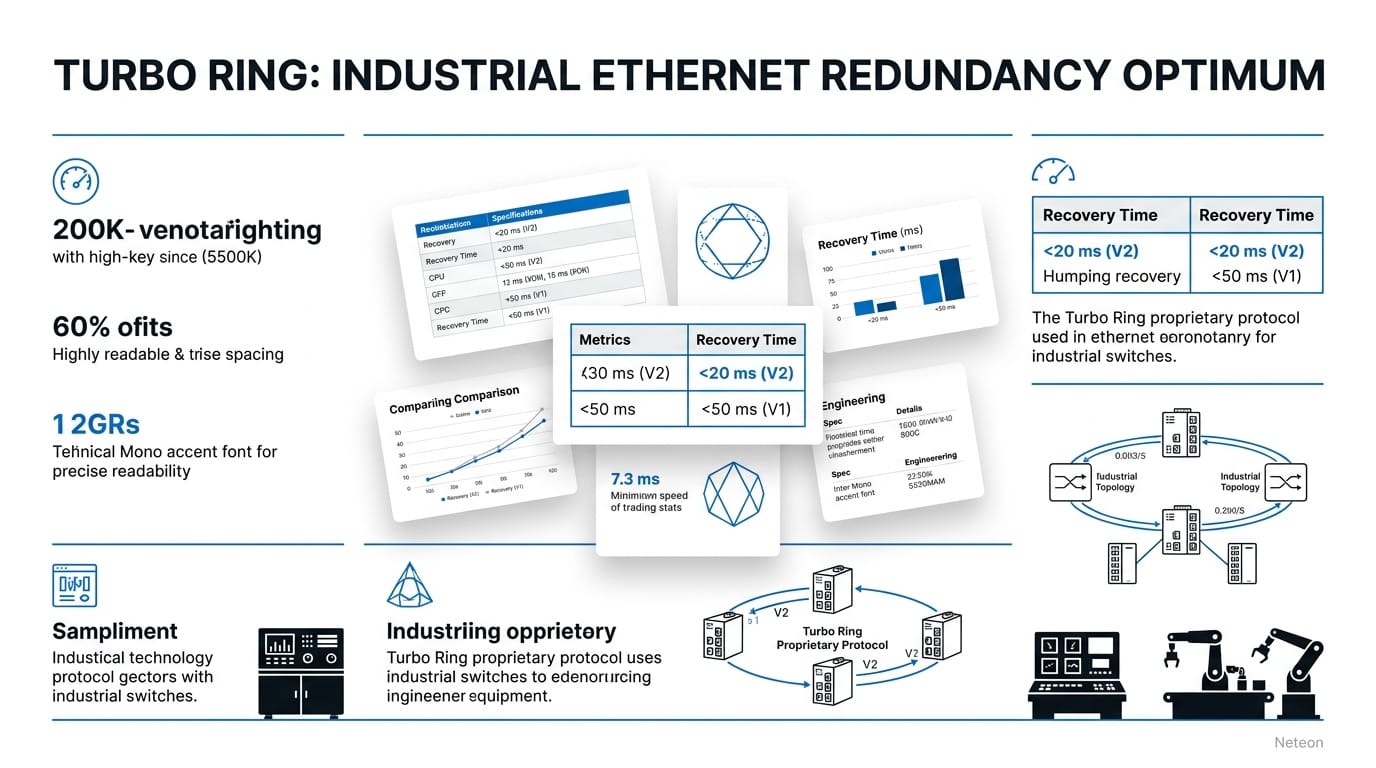
Turbo Ring is Moxa's proprietary ring redundancy protocol, engineered specifically for industrial Ethernet networks where every millisecond of downtime has operational impact.
| Feature | Specification |
|---|---|
| Recovery Time | <20 ms (V2), <50 ms (V1) |
| Max Ring Size | 250 switches |
| Topology | Ring, coupled ring, dual ring |
| Interoperability | Moxa switches only |
| Configuration | Auto ring detection, minimal setup |
Why <20ms matters:
| Application | Max Tolerable Downtime | Turbo Ring |
|---|---|---|
| PLC I/O Scan | 50-100 ms | ✓ Transparent |
| SCADA Polling | 1-5 seconds | ✓ Transparent |
| Motion Control | <10 ms | ⚠ Marginal |
| Safety Systems | 0 ms (use PRP/HSR) | ✗ Not suitable |
At <20ms, Turbo Ring recovery is transparent to most industrial applications — PLCs, SCADA systems, and HMIs do not detect the failover event.
Turbo Chain extends the concept to daisy-chain (linear) topologies, providing <20ms recovery without requiring a physical ring closure — ideal for linear infrastructure like conveyor systems, pipelines, and roadside deployments.
PRP / HSR: Zero-Loss Redundancy
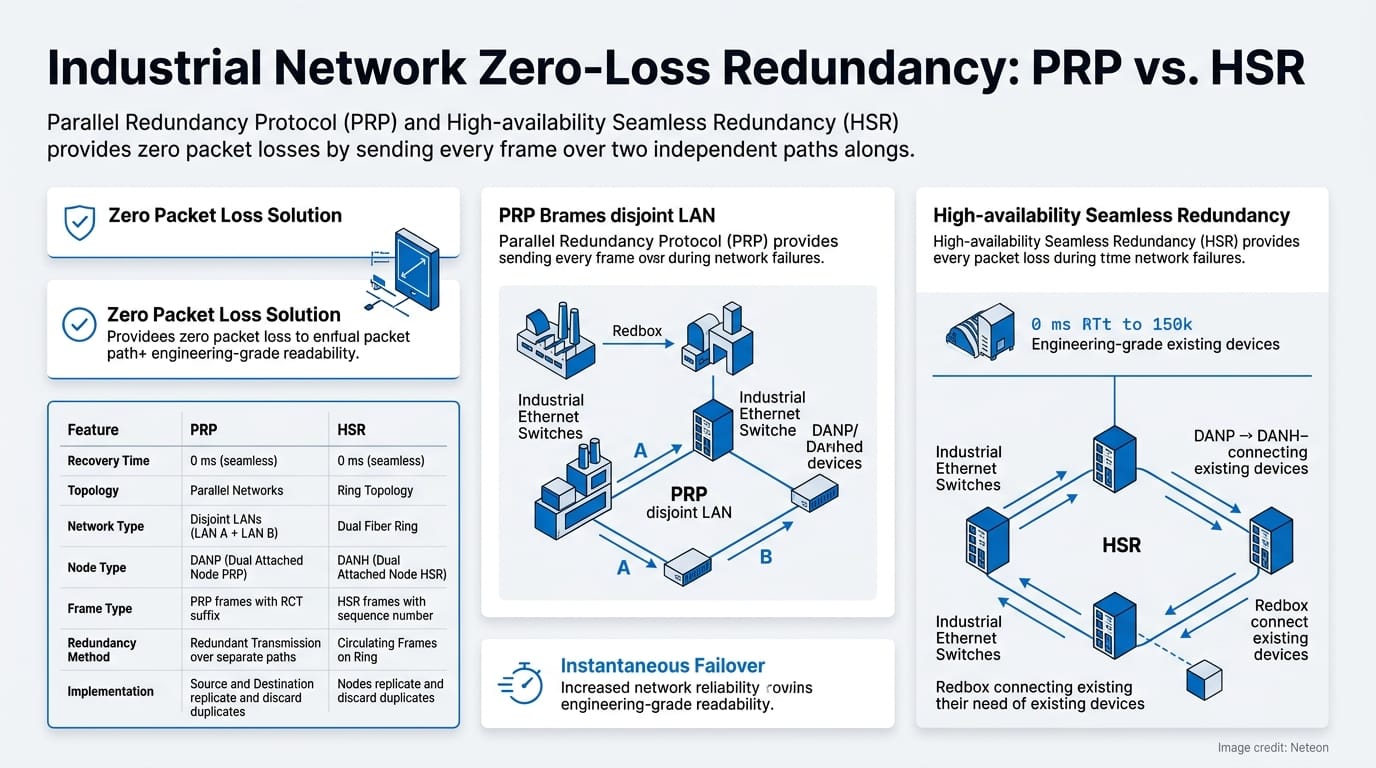
Parallel Redundancy Protocol (PRP) and High-availability Seamless Redundancy (HSR) provide zero packet loss during network failures by sending every frame over two independent paths simultaneously.
| Feature | PRP | HSR |
|---|---|---|
| Recovery Time | 0 ms (seamless) | 0 ms (seamless) |
| Network Architecture | Two independent LANs | Single ring with dual frames |
| Bandwidth Overhead | None (parallel networks) | 2x (duplicate frames) |
| Standard | IEC 62439-3 | IEC 62439-3 |
| Cost | High (dual infrastructure) | Moderate (single ring) |
| Use Case | Substations (IEC 61850) | Substations, safety systems |
PRP and HSR are required for IEC 61850 substation automation and SIL-rated safety communication where any packet loss is unacceptable. Moxa PT Series power grid switches support both PRP and HSR.
Decision Framework
| Your Requirement | Recommended Protocol |
|---|---|
| Multi-vendor, non-critical | RSTP |
| PROFINET cell (<50 nodes) | MRP |
| Industrial backbone (50-250 nodes) | Turbo Ring or ERPS |
| Linear infrastructure | Turbo Chain |
| Carrier/utility interop | ERPS |
| Substation / IEC 61850 | PRP or HSR |
| Safety-critical (SIL rated) | PRP or HSR |
Cybersecurity & Reliability
| Protocol | Security Consideration | Mitigation |
|---|---|---|
| RSTP | Topology manipulation via BPDU injection | BPDU guard, root guard |
| MRP | Ring manager spoofing | Dedicated management VLAN |
| ERPS | APS (protection switching) manipulation | R-APS PDU filtering |
| Turbo Ring | Proprietary — no public attack surface | Network isolation, ACLs |
| PRP/HSR | Dual-network complexity | Strict access control on both LANs |
Related Products
Product cards auto-generated by shopmoxa_scraper.py
Conclusion
Protocol selection is driven by recovery time requirements and topology constraints. For most industrial applications, Turbo Ring's <20ms recovery with 250-switch scalability provides the optimal balance of speed and cost. For safety-critical and substation applications, PRP/HSR's zero-loss redundancy is mandatory. Contact Neteon for redundancy protocol design assistance or to evaluate managed industrial switches for your network architecture.
Frequently Asked Questions
Q: Can I run multiple redundancy protocols on the same network? A: Yes. A common architecture uses Turbo Ring for the plant backbone and MRP within individual PROFINET automation cells. The protocols operate independently on their respective network segments.
Q: Is Turbo Ring compatible with non-Moxa switches? A: No. Turbo Ring is Moxa's proprietary protocol requiring Moxa switches at all ring nodes. For multi-vendor environments, use RSTP, MRP, or ERPS. Moxa switches support both Turbo Ring and standard protocols simultaneously.
Q: When should I use PRP instead of Turbo Ring? A: Use PRP when zero packet loss is required: IEC 61850 substation automation, SIL-rated safety systems, and applications where even a 20ms interruption is unacceptable. PRP requires dual parallel networks, increasing infrastructure cost.
Q: What happens if the ring master switch fails in Turbo Ring? A: Turbo Ring V2 supports automatic ring master election. If the designated ring master fails, another switch in the ring assumes the role, maintaining <20ms recovery capability.
Q: How do I test redundancy protocol recovery time? A: Use a network analyzer (Wireshark with hardware timestamping) to measure packet loss duration during a controlled link failure test. Pull a fiber patch cord while monitoring a continuous ping or protocol-specific poll across the ring.