TL;DR
Industrial Ethernet shares the same IEEE 802.3 foundation as commercial Ethernet but differs fundamentally in environmental ratings, connector durability, redundancy protocols, and lifecycle expectations. Understanding these differences is critical for specifying network infrastructure that survives harsh industrial conditions while meeting uptime requirements of 99.999%.
The Common Foundation
Industrial and commercial Ethernet both use the IEEE 802.3 standard — same frames, same MAC addressing, same switching principles. The physical layer is where they diverge dramatically. A commercial switch in a climate-controlled server room faces none of the challenges that an industrial switch encounters on a factory floor: extreme temperatures, electromagnetic interference, vibration, dust, and corrosive atmospheres.
This is not about premium branding. It is about engineering for fundamentally different operating conditions.
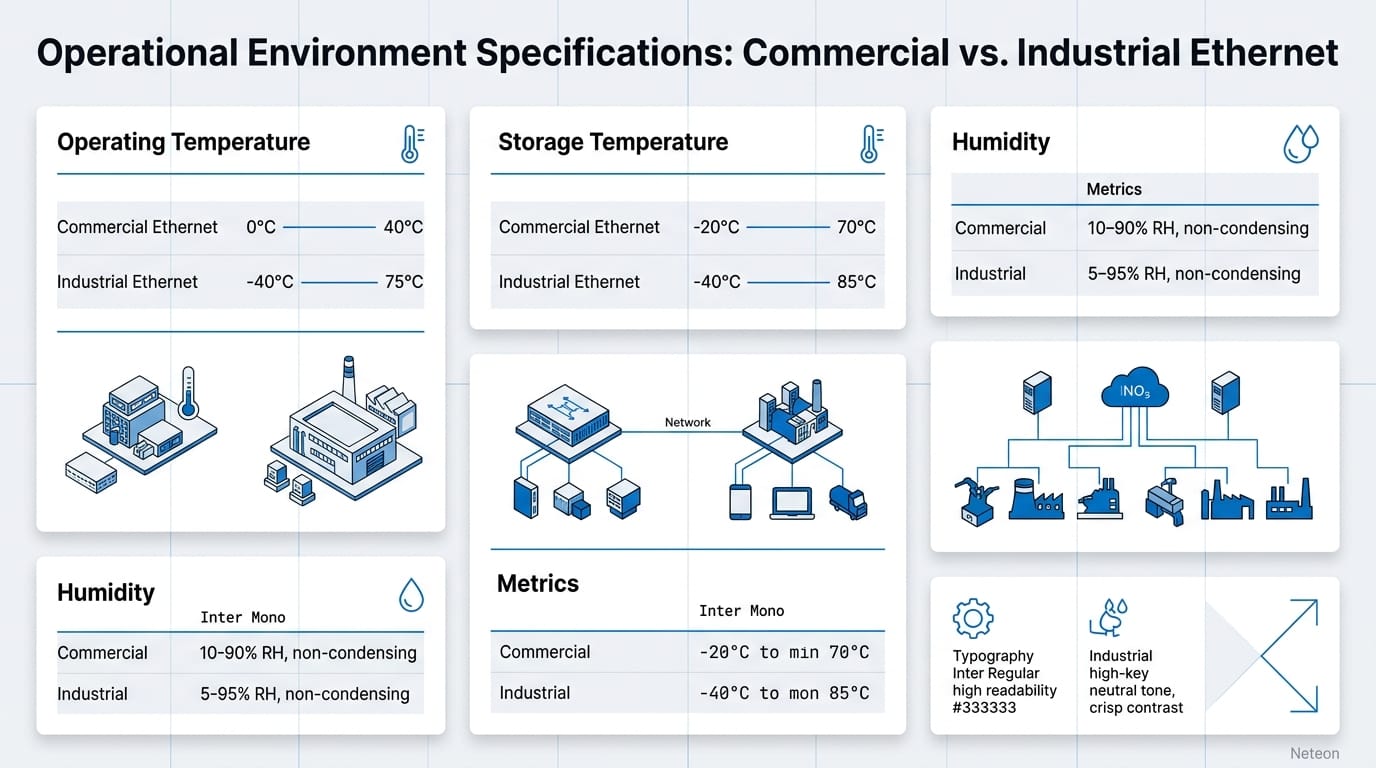
Environmental Specifications
| Parameter | Commercial Ethernet | Industrial Ethernet |
|---|---|---|
| Operating Temperature | 0°C to 40°C | -40°C to 75°C (wide-temp) |
| Storage Temperature | -20°C to 70°C | -40°C to 85°C |
| Humidity | 10-90% RH, non-condensing | 5-95% RH, condensing |
| Vibration | None rated | IEC 60068-2-6 (5G, 10-500Hz) |
| Shock | None rated | IEC 60068-2-27 (50G, 11ms) |
| EMC/EMI | FCC Part 15 Class B | IEC 61000-6-2 (industrial immunity) |
| Ingress Protection | None (open chassis) | IP30-IP67 (dust/water protection) |
| MTBF | 30,000-80,000 hours | 500,000-1,000,000+ hours |
The temperature specification alone eliminates commercial switches from most industrial deployments. A factory floor near furnaces, an outdoor substation in Minnesota winters, or a compressor station in Texas summers all exceed commercial temperature ratings within normal operation.
Connectors and Cabling
Commercial Ethernet uses standard RJ45 connectors — adequate for office environments but prone to failure under vibration. Industrial Ethernet commonly uses:
| Connector Type | Application | Advantage |
|---|---|---|
| M12 D-coded | Standard industrial Ethernet | IP67 rated, vibration-resistant, screw-lock |
| M12 X-coded | 10 Gigabit industrial | Cat6A performance with industrial rating |
| RJ45 with lock | Cabinet/panel installations | Standard compatibility with retention |
| Fiber (SC/LC) | Long distance, EMI-prone areas | Immune to electromagnetic interference |
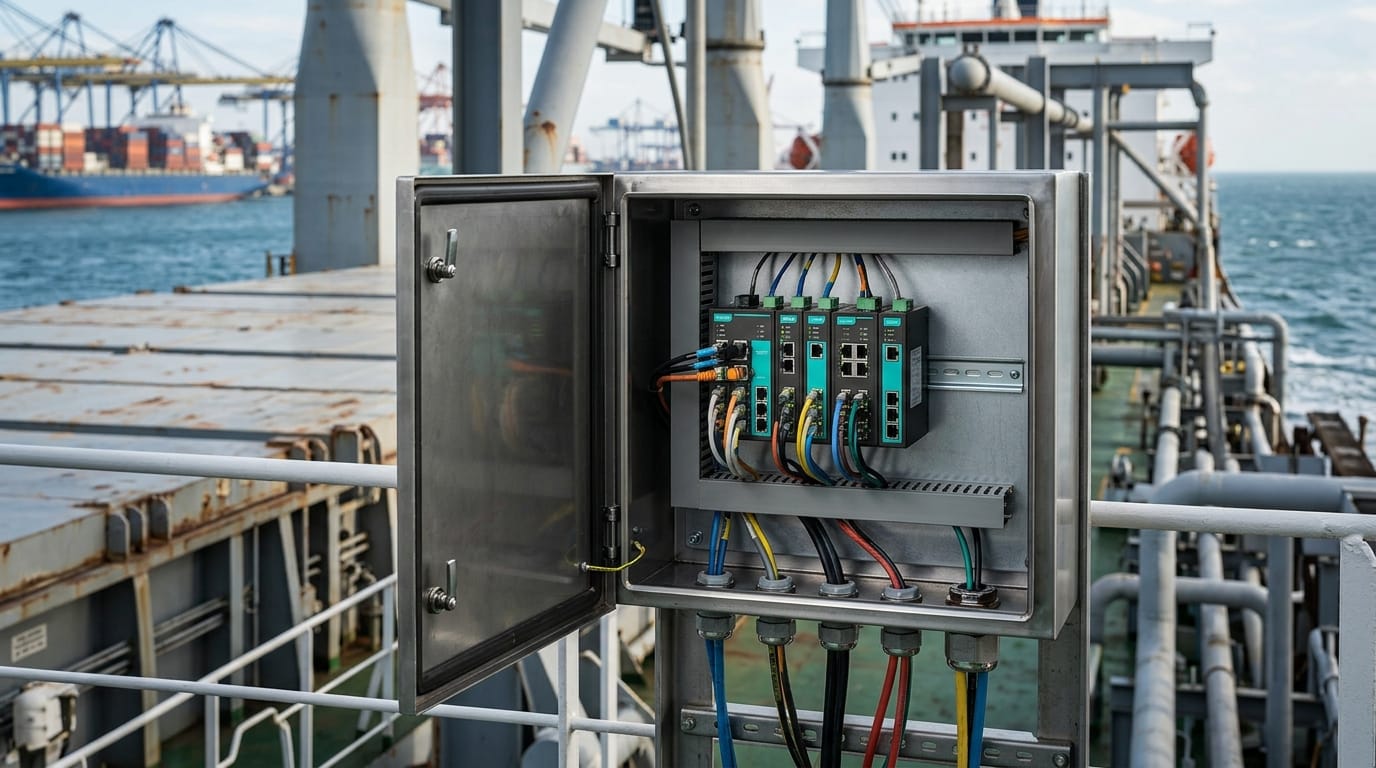
The M12 connector's screw-lock mechanism prevents disconnection under vibration — a common failure mode with RJ45 in industrial settings. Moxa's industrial switches offer both M12 and RJ45 variants to match deployment requirements.
Network Redundancy
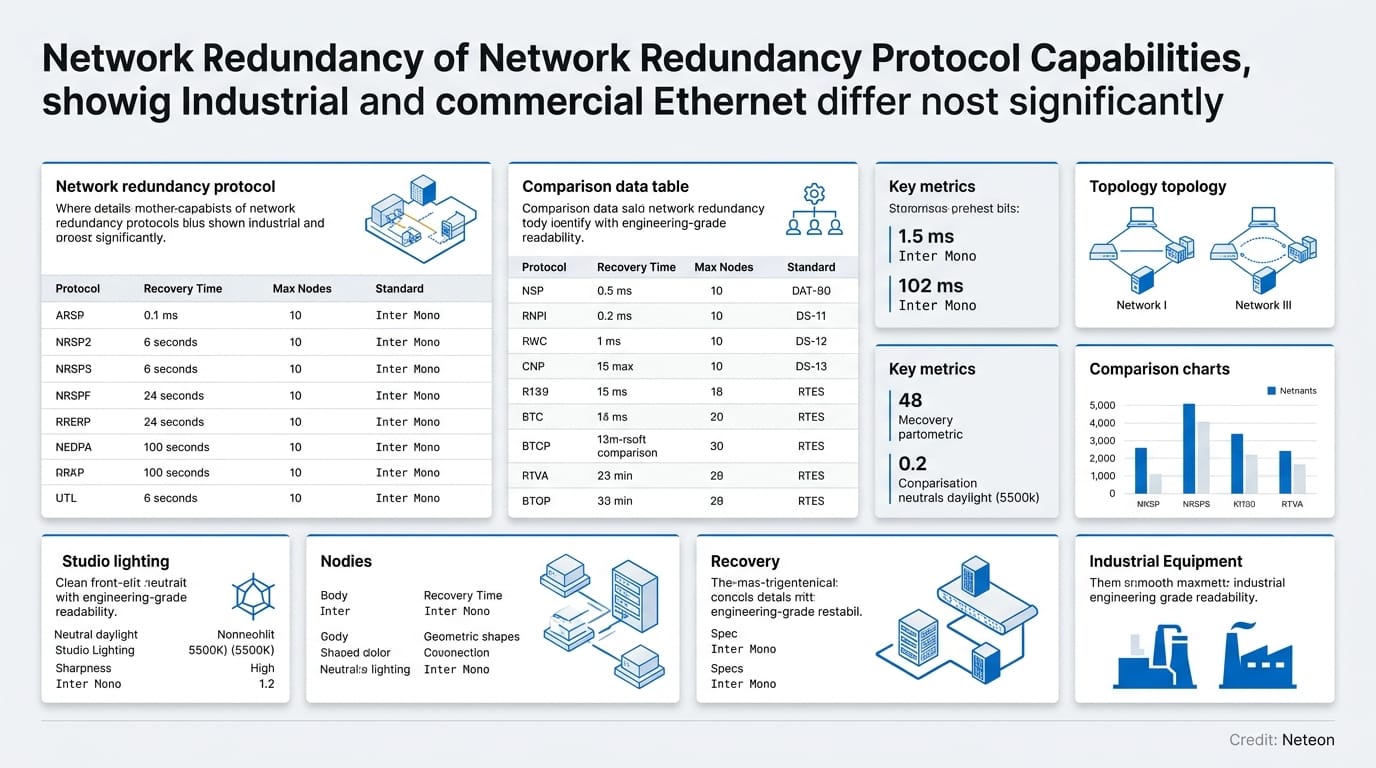
This is where industrial and commercial Ethernet differ most significantly in protocol capabilities:
| Protocol | Recovery Time | Max Nodes | Standard |
|---|---|---|---|
| STP/RSTP | 1-30 seconds | Unlimited | IEEE 802.1D/w |
| MRP | <200ms | 50 | IEC 62439-2 |
| ERPS | <50ms | 255 | ITU-T G.8032 |
| Turbo Ring | <20ms | 250 | Moxa proprietary |
| Turbo Chain | <20ms | 250 | Moxa proprietary |
| PRP/HSR | 0ms (seamless) | Limited | IEC 62439-3 |
In commercial networking, a 30-second RSTP reconvergence is acceptable — users experience a brief interruption. In industrial networking, 30 seconds of network downtime can mean a blown batch in pharmaceutical manufacturing, a safety system blind spot in a refinery, or a train communication failure.
Turbo Ring provides <20ms recovery with up to 250 switches in the ring — over 1,000x faster than standard STP. For substation automation and safety-critical applications, PRP (Parallel Redundancy Protocol) provides zero-loss failover by sending duplicate frames over two independent networks.
Power and Mounting
| Feature | Commercial | Industrial |
|---|---|---|
| Power Input | 100-240VAC (single) | 12-48VDC (dual redundant) |
| PoE Budget | Up to 740W (48-port) | Up to 120W (ruggedized) |
| Mounting | 19" rack / desktop | DIN-rail / wall-mount / IP67 box |
| Power Redundancy | Optional UPS | Dual DC inputs standard |
| Relay Output | None | Alarm relay for fault notification |
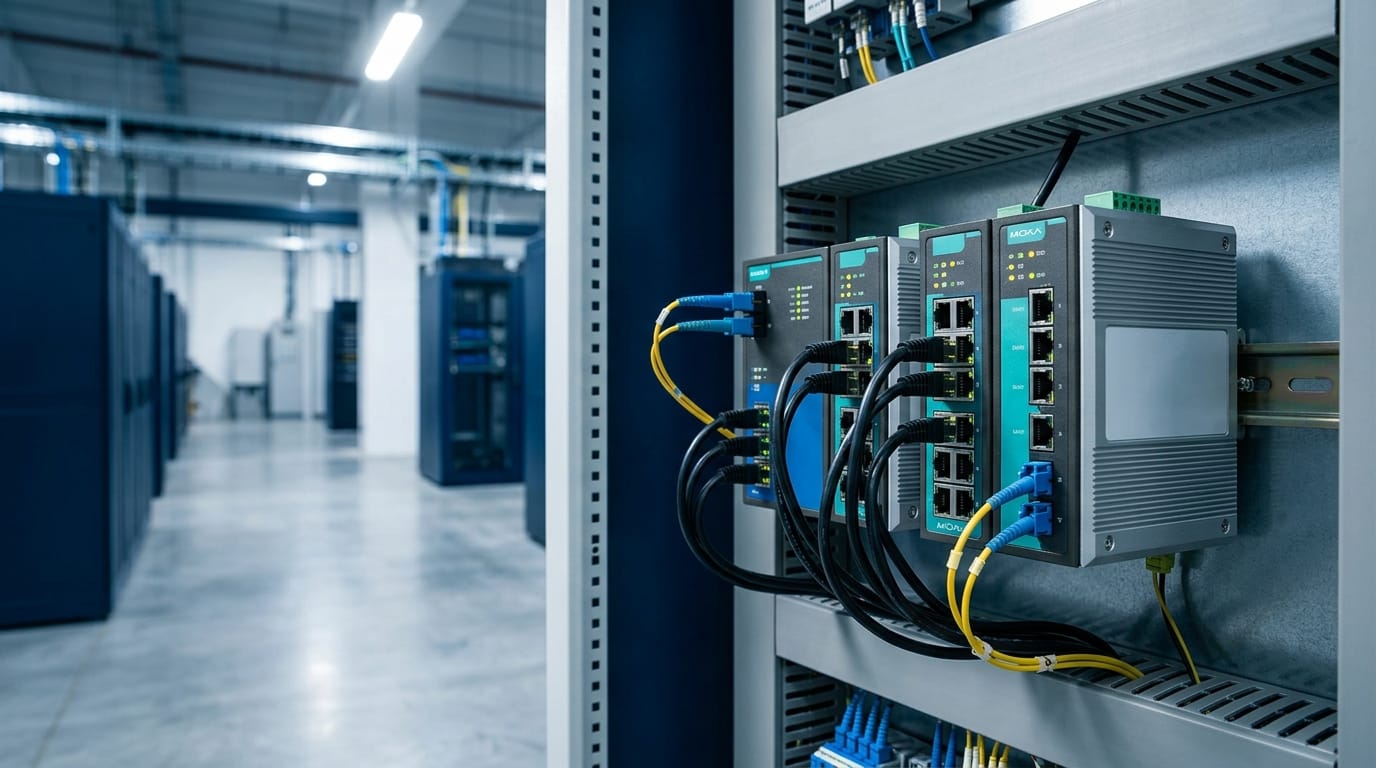
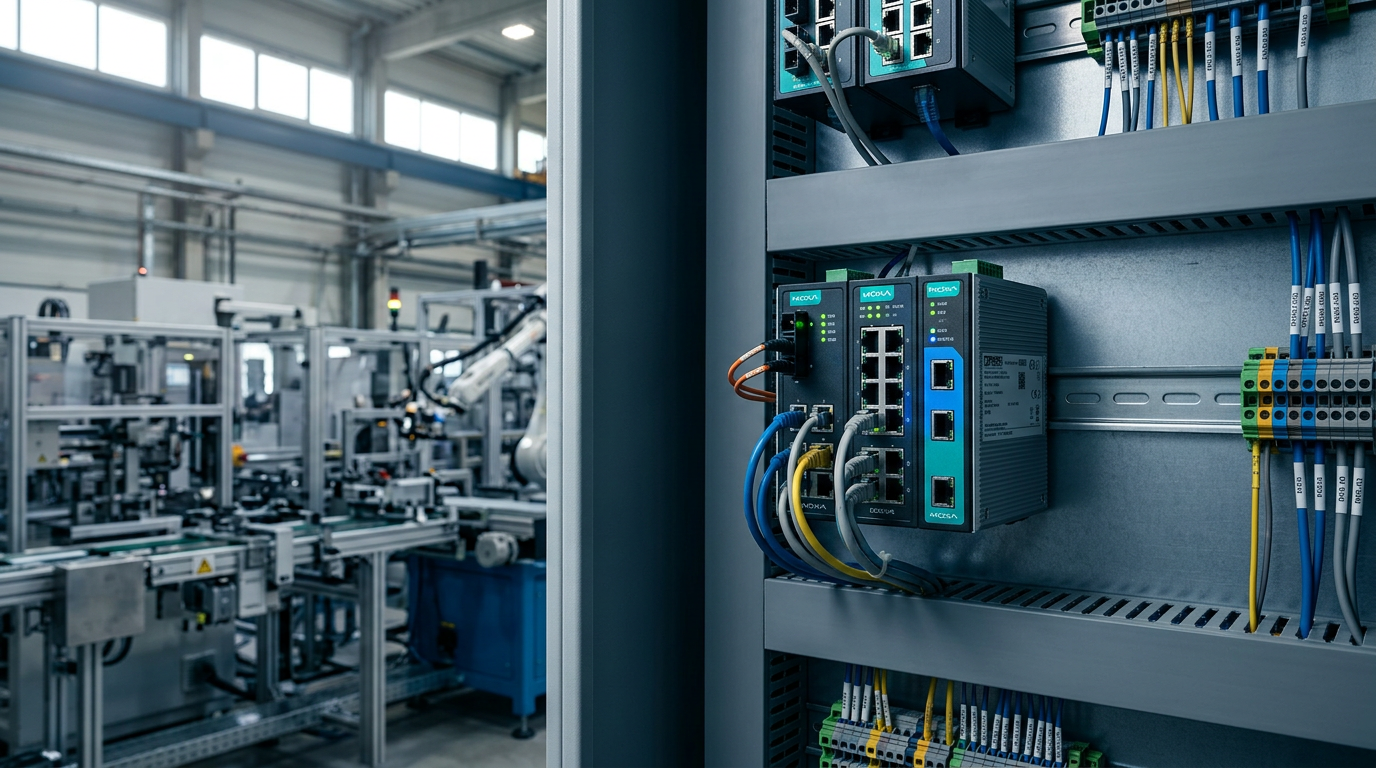
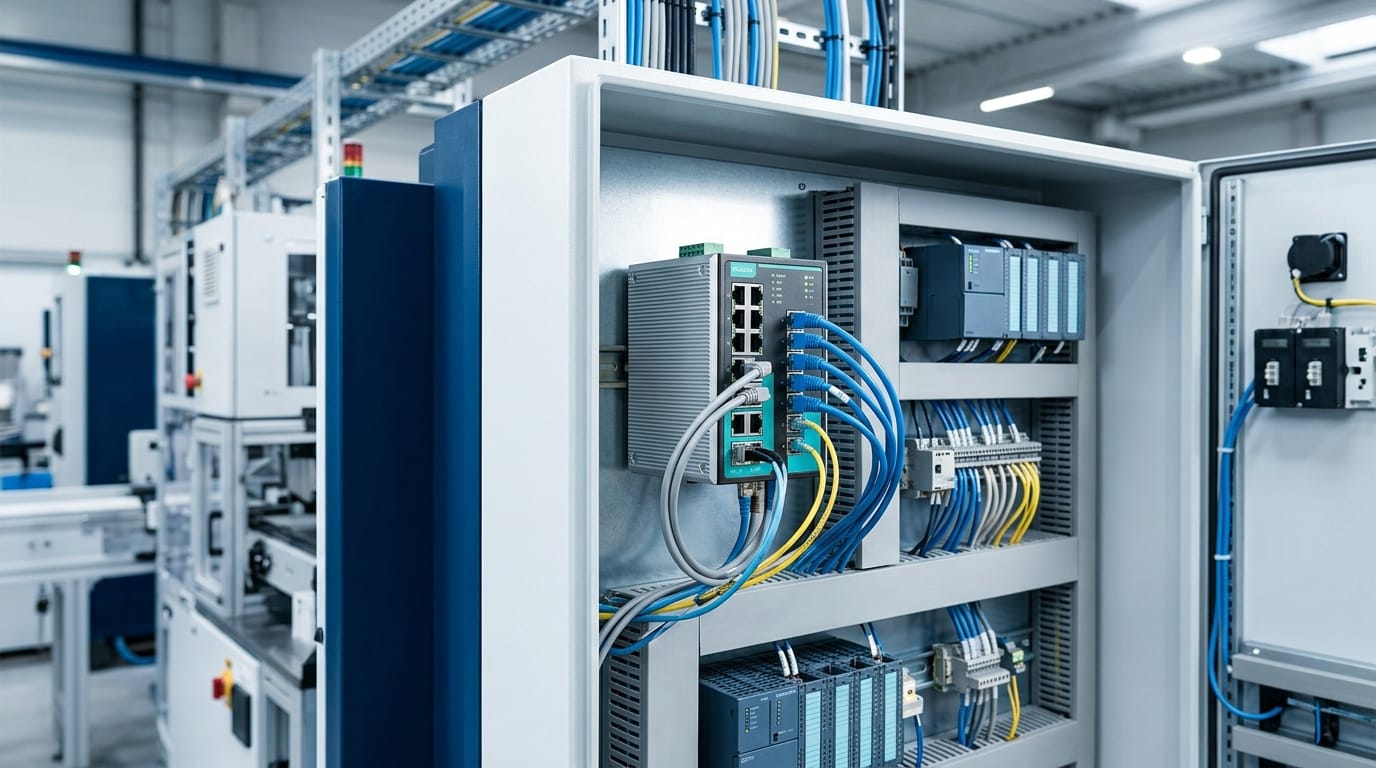
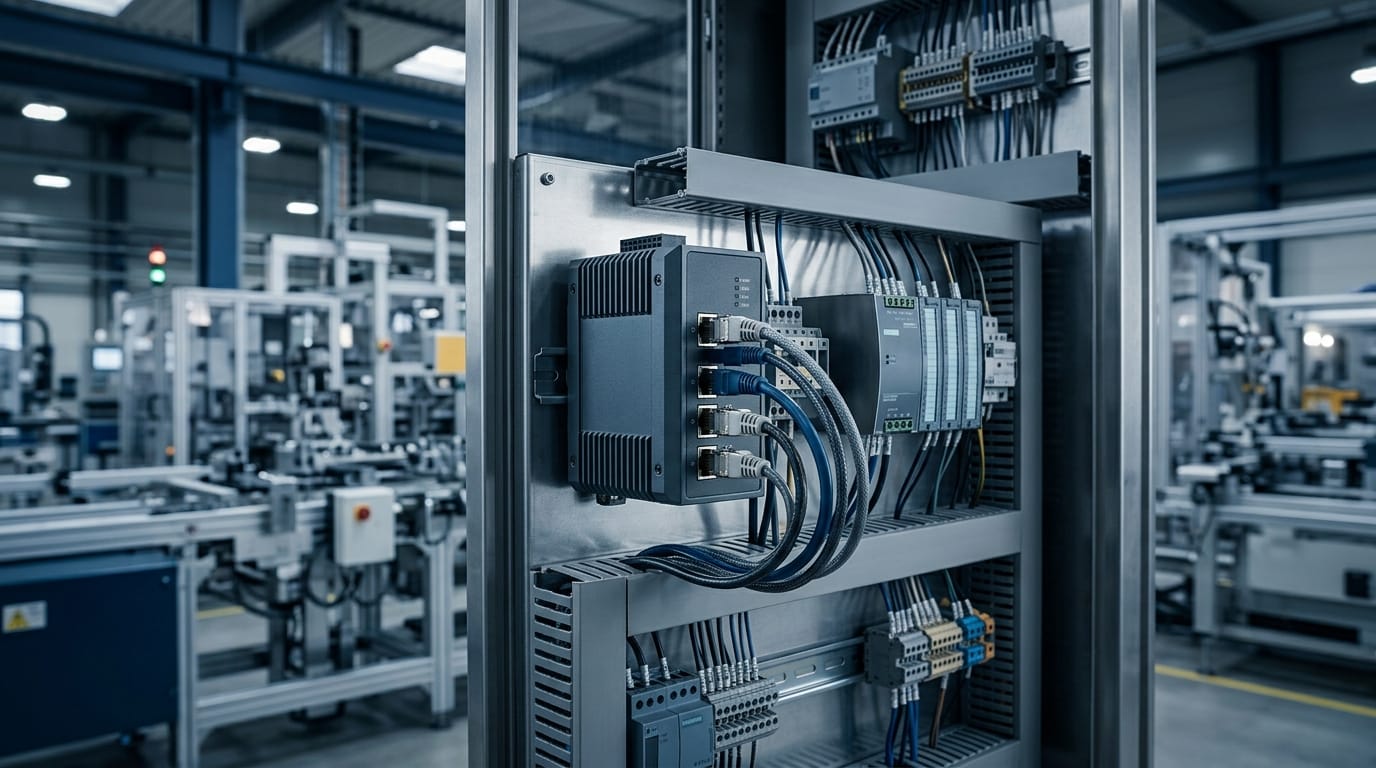
Industrial switches mount on DIN rails inside control cabinets alongside PLCs and I/O modules. Dual redundant DC power inputs ensure the switch continues operating even if one power supply fails — a feature that does not exist in commercial switching.
Industrial Protocol Support
Beyond standard Ethernet switching, industrial switches support:
- PROFINET — real-time industrial automation (conformance class B/C)
- EtherNet/IP — Rockwell/ODVA automation protocol
- Modbus TCP — legacy industrial protocol support
- IEEE 1588 PTP — sub-microsecond time synchronization
- IGMP snooping — multicast control for industrial protocols
These protocols have specific QoS and latency requirements that commercial switches are not designed to handle.
Cybersecurity & Reliability
| Security Feature | Commercial | Industrial |
|---|---|---|
| Port Security | MAC filtering | MAC filtering + 802.1X + RADIUS |
| Management | SNMPv2c, HTTP | SNMPv3, HTTPS, SSH, TLS |
| Hardening | Basic | IEC 62443-4-2 certified options |
| Firmware | Auto-update | Controlled update with integrity check |
| Lifecycle | 3-5 years | 10-15+ years with long-term support |
Industrial Ethernet devices like the Moxa EDS Series are designed for 10-15+ year lifecycles with guaranteed firmware support — matching the lifecycle of industrial automation equipment they connect.
Related Products
Product cards auto-generated by shopmoxa_scraper.py
Conclusion
Deploying commercial Ethernet in industrial environments introduces unnecessary risk: temperature failures, connector disconnections under vibration, inadequate redundancy recovery times, and short product lifecycles. Industrial Ethernet switches are engineered from the ground up for the demands of factory floors, substations, transportation systems, and hazardous locations. Contact Neteon for guidance on specifying the right industrial networking equipment for your application.
Frequently Asked Questions
Q: Can I use commercial switches in a climate-controlled industrial cabinet? A: While temperature may be controlled, commercial switches still lack vibration resistance, EMC immunity, redundant power inputs, and industrial-grade MTBF. The risk of failure and resulting downtime cost typically exceeds the price difference.
Q: What is the price difference between industrial and commercial switches? A: Industrial switches cost 3-10x more per port than commercial equivalents. However, when factoring in 15+ year lifecycle, reduced downtime costs, and lower total cost of ownership, industrial switches are often more economical for production-critical applications.
Q: Do I need M12 connectors or can I use RJ45? A: Use M12 in environments with vibration (manufacturing, transportation, marine) or moisture exposure. RJ45 with locking tabs is acceptable inside sealed control cabinets. The choice depends on your specific environmental conditions.
Q: What is Turbo Ring and how is it different from RSTP? A: Turbo Ring is Moxa's proprietary redundancy protocol providing <20ms failover with up to 250 switches in a ring topology. RSTP provides 1-30 second recovery. For applications requiring high availability (manufacturing, utilities, transportation), Turbo Ring's speed is critical.
Q: How do I migrate from commercial to industrial Ethernet? A: Start with the most critical network segments (safety systems, production-critical PLCs). Industrial switches are drop-in replacements at the Ethernet layer — same IP addressing, same VLANs. The migration is a physical swap with enhanced configuration for industrial protocols and redundancy.