TL;DR
IEEE 802.1 TSN Standards Explained: Qbv, Qbu, AS, and More — this comprehensive guide provides engineers and system integrators with practical, data-driven insights into manufacturing automation and TSN networking. Covering key standards (IEEE 802.1 TSN (Qbv, Qbu, AS), PROFINET, EtherNet/IP), technical specifications, and deployment best practices, this article helps decision-makers select and implement the right solutions for their manufacturing & tsn requirements.
Industry Overview
The manufacturing automation and TSN networking landscape is evolving rapidly as organizations modernize their operational technology infrastructure. Engineers face growing challenges: deterministic latency, network convergence, multi-protocol coexistence, real-time control. This guide addresses these challenges with practical solutions backed by technical specifications and real-world deployment data.
Understanding the requirements starts with the standards that govern this domain. Key standards include IEEE 802.1 TSN (Qbv, Qbu, AS), PROFINET, EtherNet/IP, each addressing specific aspects of system design, security, and interoperability.
| Standard | Focus Area | Relevance to Manufacturing & TSN |
|---|---|---|
| IEEE 802.1 TSN (Qbv | Primary compliance | Foundation for system design |
| IEC 62443 | Cybersecurity | Network security architecture |
| IEEE 802.3 | Ethernet | Physical layer requirements |
The Challenge
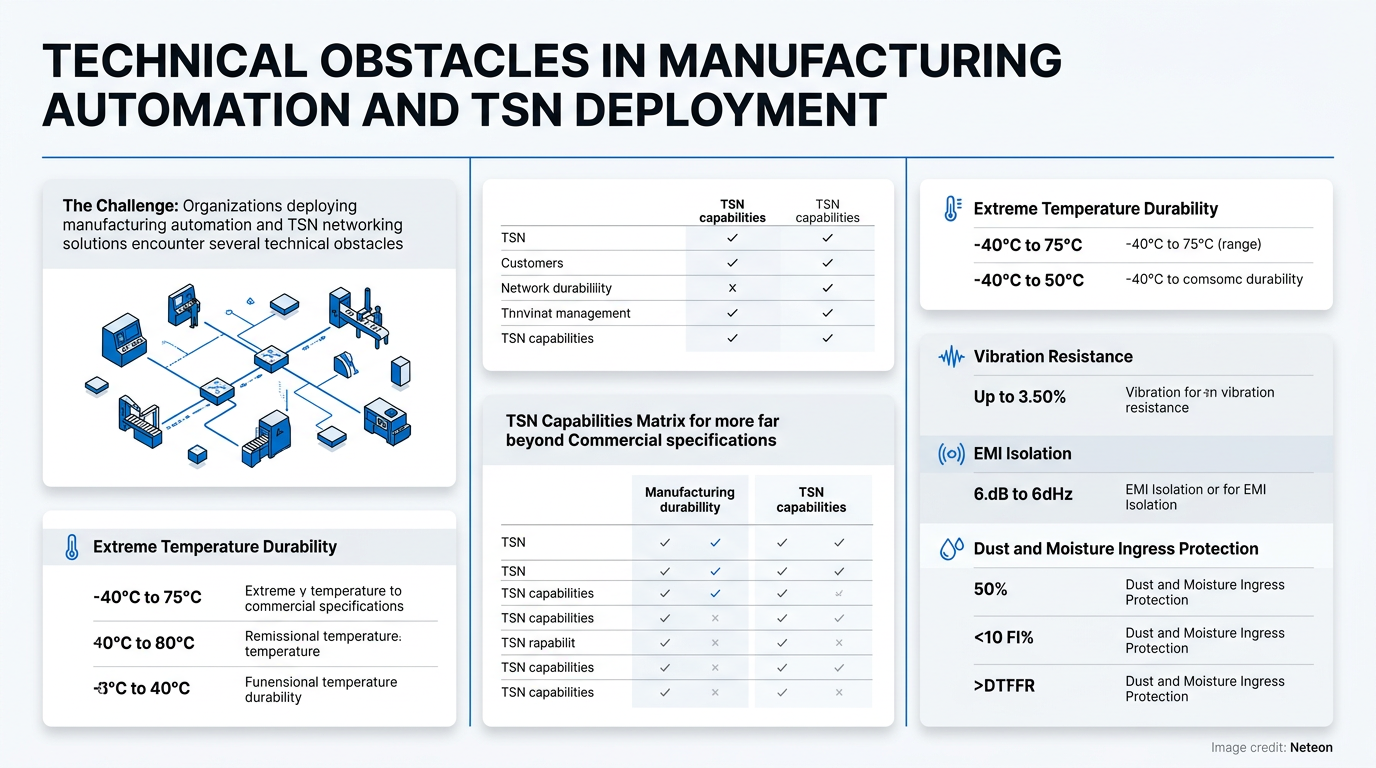
Organizations deploying manufacturing automation and TSN networking solutions encounter several technical obstacles:
Environmental constraints — Industrial environments impose requirements far beyond commercial specifications. Temperature extremes (-40°C to 75°C), vibration, EMI, dust, and moisture demand purpose-built equipment rated for these conditions.
Protocol diversity — Multiple communication protocols must coexist on the same network infrastructure. Legacy serial protocols (Modbus RTU, DNP3) need to communicate with modern Ethernet-based systems, requiring protocol gateways and careful network design.
Availability requirements — Critical infrastructure demands 99.999% uptime, translating to less than 5.26 minutes of downtime per year. This requires redundant network paths with sub-second failover capabilities.
| Requirement | Standard Solution | Industrial Solution |
|---|---|---|
| Temperature | 0-40°C (commercial) | -40 to 75°C (wide-temp) |
| Redundancy | STP (30-50 sec) | Turbo Ring (<20ms) |
| Protocols | TCP/IP only | Multi-protocol (Modbus, DNP3, OPC UA) |
| Lifecycle | 3-5 years | 10-15+ years |
| Security | IT-grade | IEC 62443 OT-grade |
The Solution
Effective solutions for manufacturing automation and TSN networking combine purpose-built hardware with proper network architecture:
1. Network Architecture Design
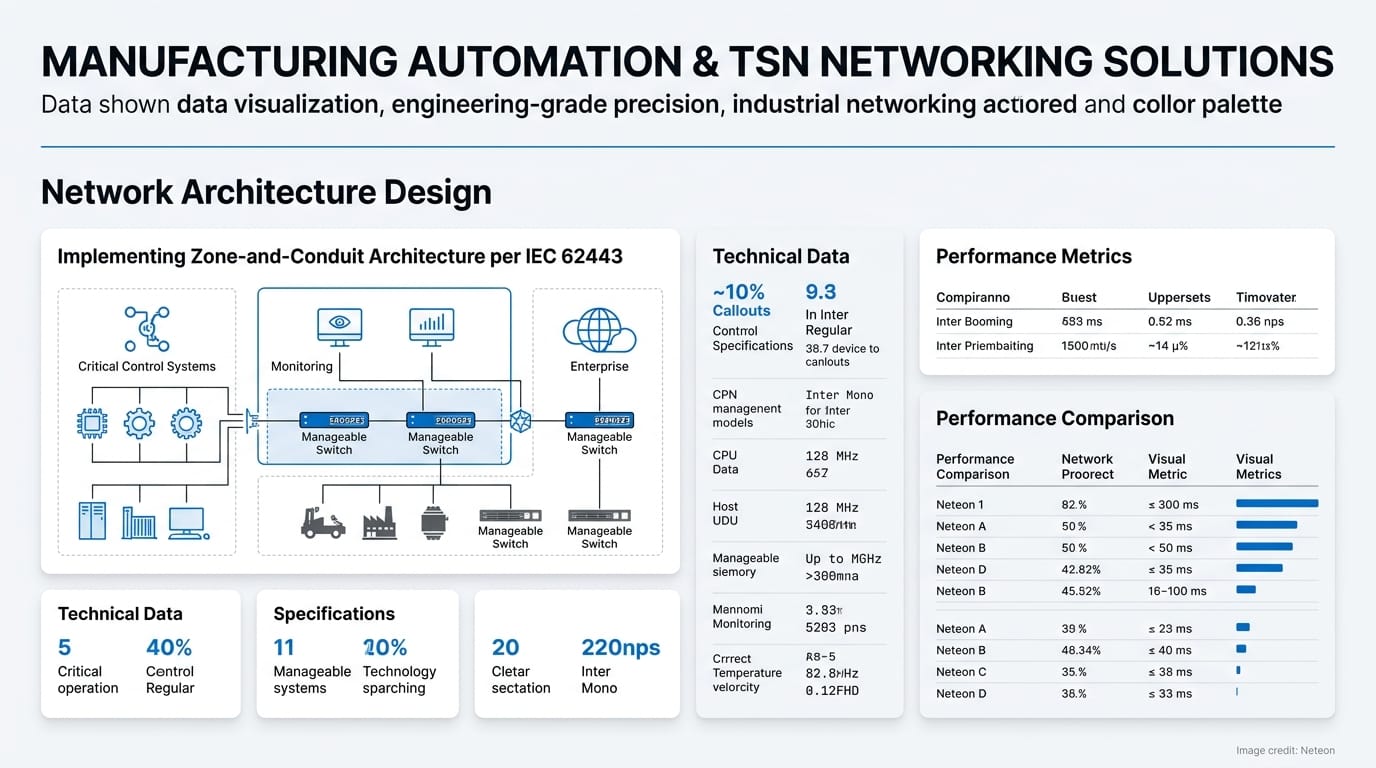
Implement zone-and-conduit architecture per IEC 62443. Separate critical control systems, monitoring, and enterprise traffic using VLAN segmentation on managed industrial switches.
| Zone | Function | Security Level | Networking |
|---|---|---|---|
| Critical Control | Safety, protection | SL 3 | Dedicated VLAN, PRP/HSR |
| Process Control | SCADA, DCS, PLC | SL 2-3 | Managed switches, Turbo Ring |
| Monitoring | Historians, analytics | SL 2 | Standard managed Ethernet |
| Enterprise | IT, office, remote | SL 1-2 | IT switches, DMZ boundary |
2. Equipment Selection
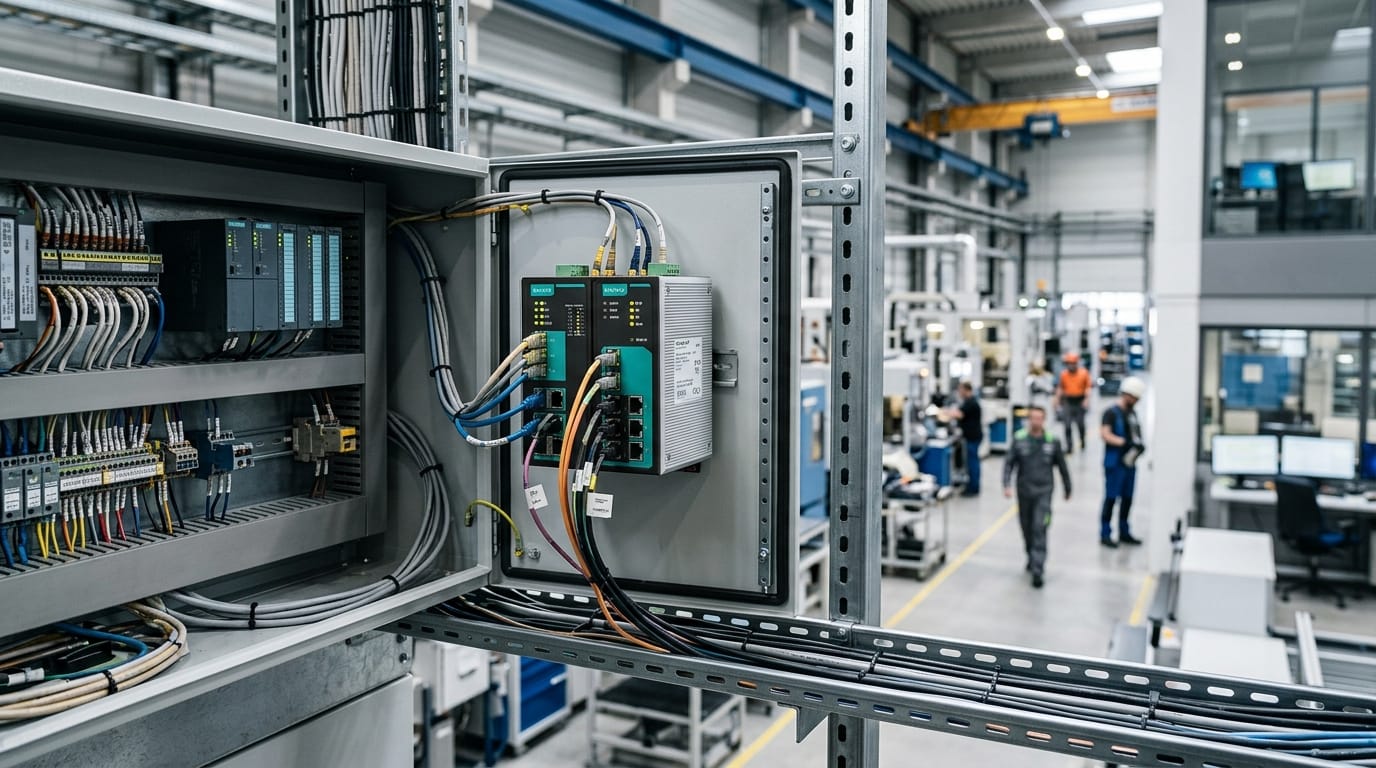
Select industrial networking equipment rated for the deployment environment. Moxa TSN-enabled switches and industrial networking equipment provide the environmental ratings, protocol support, and redundancy capabilities required for reliable operation.
| Feature | Specification | Benefit |
|---|---|---|
| Operating Temp | -40°C to 75°C | Reliable operation in extreme conditions |
| Redundancy | Turbo Ring <20ms | Transparent failover for critical systems |
| Security | IEC 62443-4-2 SL2+ | Compliant cybersecurity posture |
| Management | SNMPv3, HTTPS, SSH | Secure remote monitoring and configuration |
3. Implementation Best Practices
| Phase | Duration | Activities |
|---|---|---|
| Design | 2-4 weeks | Network topology, equipment specification, VLAN plan |
| Deploy | 4-8 weeks | Equipment installation, configuration, cable routing |
| Commission | 1-2 weeks | Testing, redundancy verification, documentation |
| Optimize | Ongoing | Monitoring, firmware updates, capacity planning |
Cybersecurity & Reliability
| Security Layer | Implementation | Standard Compliance |
|---|---|---|
| Network Segmentation | VLAN + firewall zones | IEC 62443-3-3 FR5 |
| Access Control | 802.1X, RADIUS, RBAC | IEC 62443-3-3 FR1-2 |
| Monitoring | SNMP, syslog, MXview One | IEC 62443-3-3 FR6 |
| Device Hardening | Disable unused ports/services | IEC 62443-4-2 |
| Redundancy | Turbo Ring, dual power | Availability targets |
Reliability specifications: - MTBF: >500,000 hours for industrial switches - Failover: <20ms with Turbo Ring, 0ms with PRP/HSR - Power: Dual redundant DC inputs (12-48VDC) - Environmental: IEC 60068-2-6 vibration, IEC 60068-2-27 shock
Related Products
Product cards auto-generated by shopmoxa_scraper.py
Conclusion
Successful manufacturing automation and TSN networking deployments require purpose-built industrial networking equipment, proper network architecture, and adherence to relevant standards. Starting with a thorough requirements analysis and implementing zone-based security architecture provides a solid foundation for reliable, secure operations. For technical specifications, network design assistance, or application engineering support, contact Neteon's engineering team or explore our industrial networking solutions.
Frequently Asked Questions
Q: What standards should I follow for manufacturing & tsn networking? A: Key standards include IEEE 802.1 TSN (Qbv, Qbu, AS), PROFINET, EtherNet/IP. IEC 62443 provides the cybersecurity framework, while domain-specific standards address environmental and functional requirements.
Q: What is the typical ROI timeline for industrial networking upgrades? A: Most organizations achieve ROI within 12-18 months through reduced downtime (a single hour of unplanned downtime costs $10,000-$100,000+ depending on the operation), improved remote diagnostics, and lower maintenance costs.
Q: Can existing legacy equipment be integrated with modern industrial networks? A: Yes. Protocol gateways (like Moxa MGate Series) convert legacy serial protocols (Modbus RTU, DNP3) to Ethernet-based communication. This allows gradual migration without replacing all field devices simultaneously.
Q: How do I ensure cybersecurity for my manufacturing & tsn network? A: Implement IEC 62443 zone-and-conduit architecture with industrial firewalls at zone boundaries, enable 802.1X port authentication on managed switches, deploy network monitoring, and maintain a regular firmware update schedule.
Q: What redundancy protocol should I choose? A: For most industrial applications, Turbo Ring (<20ms recovery, up to 250 switches) provides the optimal balance of speed and scalability. For safety-critical systems (substations, SIL-rated), use PRP/HSR for zero-loss redundancy.